

acceleration
 20
4.0
20
4.0

- noun
- /əˌsɛləˈreɪʃən/
- Specialized
- The human body can withstand these accelerations.
- angular acceleration
- velocity and acceleration
- acceleration and deceleration
Loading YouTube…
Watch on YouTubeYou don't notice MOND near massive bodies because the acceleration is too high.
- You don't notice MOND near massive bodies because the acceleration is too high.
- Yeah, the centrifugal acceleration is dependent on the radius.
- And by definition when your speed changes, it's an acceleration.
- But strictly speaking it's wrong because you can't just redefine what you mean by zero acceleration.
- And so most of the paper is devoted to working out whether solar radiation pressure could explain this acceleration in a moment.
- You're propelled through the world with fixed acceleration.
Examples
-
So we found out that the acceleration is proportional to the force.
-
In playing the games, students learn to understand the concepts of mass, motion, acceleration, force, and velocity.
Academic text (1990) -
Force is mass times acceleration and its force and its acceleration are always in the same direction.
-
Velocity equals acceleration times time.
-
Newton's second law states that the acceleration of an object is dependent upon two variables.
-
The rumble grew louder, and now Rick felt the acceleration begin to build.
Fiction book (1996) -
Regression analysis was used to determine the best estimate of initial acceleration and the damping factor.
Academic text (1991) -
The cabin rumbled softly, the acceleration much smoother than during the ride up through the atmosphere.
Fiction book (1996) -
In physics, acceleration refers to the rate at which an object's velocity changes over time.
-
During the experiment, we measured the acceleration of the moving car and noted its increase in speed.
Synonyms
 1
9.1
1
9.1
A short informal word for something that makes things go faster
Antonyms

Compounds

- Specialized

 1
4.6
1
4.6
A steady change in an object's speed by the same amount in equal time periods


- Specialized
A change in an object's movement that makes it move toward the centre when it follows a curve

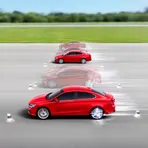
- Specialized
Movement where speed changes by different amounts over time

- Specialized
A steady change in an object's speed by the same amount each second
Surface Forms
Morphology
acceleration = accelerate (transparent) = accelerate + ion
The physics sense is a direct nominalization of 'accelerate' describing the process/rate; although technical, it follows the normal verb → noun derivation.
Etymology
Acceleration comes from the parts ad- 'to' and celer 'quick', so it carries the idea of 'making quick'. That's why, in physics, acceleration describes how fast an object's speed or direction changes.