
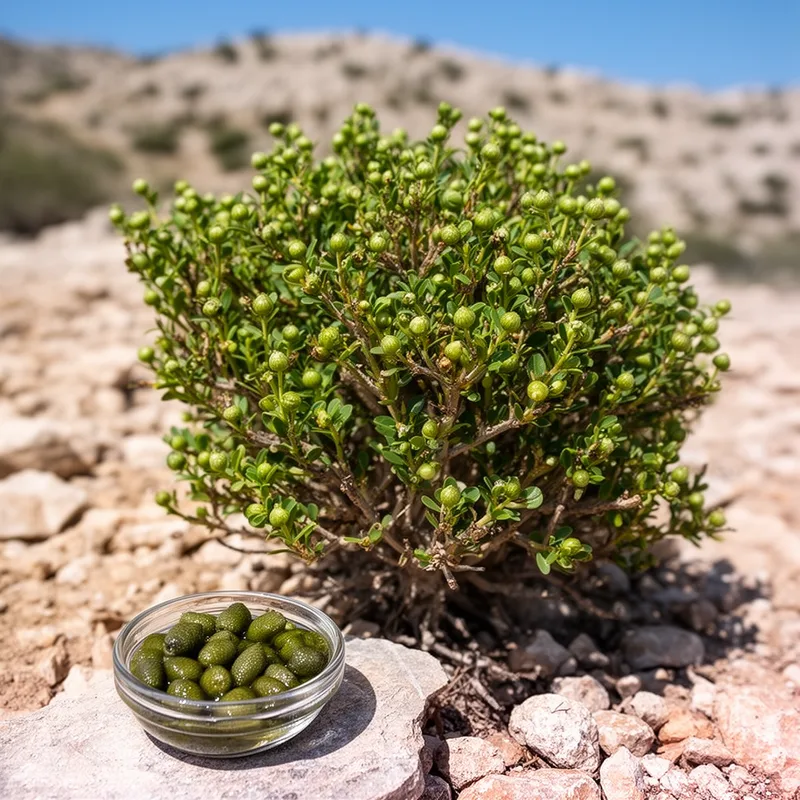
Zygophyllum fabago
- noun
- Specialized
- The flower buds of Zygophyllum fabago are sometimes pickled and used as an alternative to capers.
Examples
-
Zygophyllum fabago grows in dry, rocky soils throughout the eastern Mediterranean region.
-
Researchers have studied the medicinal properties of Zygophyllum fabago in local traditional remedies.
-
The Zygophyllum fabago grows abundantly in arid regions.
-
I learned about Zygophyllum fabago in my botany class.
-
The flower buds of Zygophyllum fabago are sometimes pickled and used as an alternative to capers.
-
Zygophyllum fabago grows in dry, rocky soils throughout the eastern Mediterranean region.
-
Researchers have studied the medicinal properties of Zygophyllum fabago in local traditional remedies.
Synonyms

A bush from the eastern Mediterranean and southwest Asia whose flower buds are used as capers in cooking
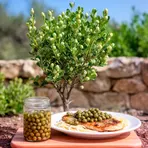
A small bush whose pickled flower buds are used in cooking
Surface Forms
Morphology
Zygophyllum + fabago
This is a Latin binomial (genus + species): knowing 'Zygophyllum' as a plant genus lets a learner infer the expression refers to a plant species, so part of the meaning (that it is a plant) is predictable. However, the specific properties given in the gloss (a perennial shrub, native range, buds used as capers) are not derivable from the constituents—'fabago' is not a transparent English word—so the overall meaning is only partially predictable.
Etymology
Zygophyllum fabago comes from old Greek and Latin words: zygo meaning 'yoke' and phyllum meaning 'leaf' because the plant's leaves grow in matching pairs, and fabago comes from 'faba' meaning 'bean' for its bean-like pods. So the name paints a simple picture of a small shrub with paired leaves and bean-like buds, and those buds are sometimes pickled and used like capers.

