

Zigadenus venenosus
- noun
- Specialized
- Accidental ingestion of Zigadenus venenosus can be fatal to sheep and cattle.
Examples
-
Livestock ranchers are especially wary of Zigadenus venenosus growing in their pastures.
-
Researchers studied the distribution of Zigadenus venenosus across various habitats in the western United States.
-
The Zigadenus venenosus is highly toxic to livestock.
-
Farmers should be aware of Zigadenus venenosus in their fields.
-
Accidental ingestion of Zigadenus venenosus can be fatal to sheep and cattle.
-
Livestock ranchers are especially wary of Zigadenus venenosus growing in their pastures.
-
The presence of Zigadenus venenosus in grazing areas poses a serious risk to animals.
Synonyms

A poisonous plant with grass-like leaves that kills grazing animals

A North American plant with grass-like leaves and white poisonous flowers
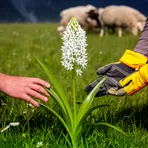
A plant with leaves like grass and small white flowers that is poisonous

A wild plant whose bulbs look like wild onions and can make animals or people sick
Surface Forms
Morphology
Zigadenus + venenosus
This binomial is compositional: it combines a genus name ('Zigadenus' — a genus of poisonous plants) with a specific epithet 'venenosus' (a Latin/Spanish-rooted form meaning 'poisonous'), so a learner who knows both constituents can infer it denotes a poisonous Zigadenus species (a toxic plant). The form is therefore directly derivable from its parts, though note 'venenosus' is a Latin epithet and may not appear in ordinary English dictionaries.
Etymology
Zigadenus venenosus is named for a deadly habit: its bulbs and flowers can look harmless or like edible plants, but if animals eat them they become sick and can die. The second word venenosus means 'poisonous' in Latin, and this is why people also call it 'meadow death camas'.

