
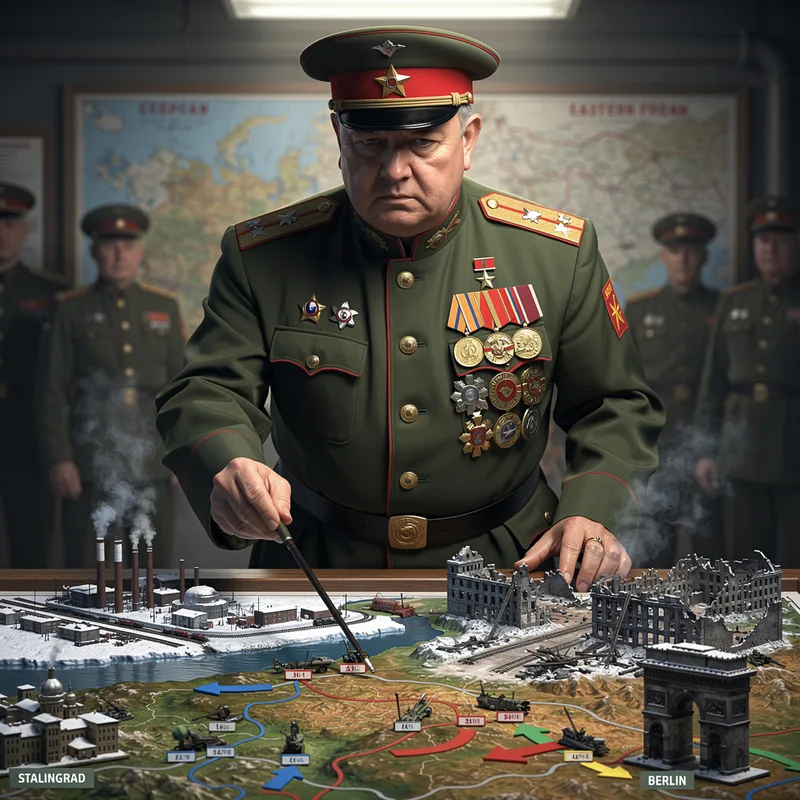
Zhukov
 5
8.0

- proper noun
- At four in the morning, a call came from the Kremlin to the guard on duty: "Wake him up immediately," Zhukov said.
- Marshal Zhukov
Loading YouTube…
Watch on YouTubeI mean, he was a dictator, of course, but nonetheless, he listened to men like Zhukov and Rokozovsky and Ivan Conye from the great Russian marshals.
- I mean, he was a dictator, of course, but nonetheless, he listened to men like Zhukov and Rokozovsky and Ivan Conye from the great Russian marshals.
Examples
-
Georgii Zhukov, later the famous Marshal Zhukov, one of the most successful Soviet commanders of the victorious Red Army in World War II, was the commander he selected for his anticipated thrust to the west.
Academic text (1996) -
The Red Army could not simply have marched a couple of hundred miles into Hitler's well-armed Germany, as Zhukov's scheme imagined, and then have retreated to its original positions.
Academic text (1996) -
The Soviets won World War II after the stupid Ike let Zhukov walk into Berlin when the US 9th Army could have secured it one week before the Soviets.
Blog text (14) -
How could either side have left the Red Army standing along lines well inside Germany after such a vast initial military success—had it been brought off as Zhukov planned for his Kremlin boss?
Academic text (1996) -
The popular victor, Marshal Zhukov, a potential rival in Stalin's view, was banished to the provinces and even banished from filmed "histories" celebrating the military triumph.
Academic text (1996) -
Andrew Roberts selected Zhukov as the general who led the Soviet counteroffensive at Stalingrad.
-
During World War II, General Zhukov played a key role in the capture of Berlin.
-
In 1942, Stalin promoted Zhukov to deputy commander-in-chief of the Red Army.
Synonyms

 1
7.7
Soviet general who led major World War II attacks at Stalingrad and Berlin
Surface Forms
Etymology
Zhukov comes from the Russian word zhuk, which means 'beetle', plus the ending -ov, which means 'of' or 'son of'. So the name originally meant 'of the beetle', and a helpful way to remember the famous general Zhukov is to picture a small, tough beetle leading an army.