

Zen
 9
5.9
9
5.9

- noun
- /zɛn/
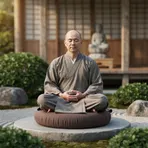
- Many people find peace and focus through Zen meditation practices.
Loading YouTube…
Watch on YouTubeI was studying Burmese Buddhism and Zen Buddhism and Tibetan Buddhism.
- I was studying Burmese Buddhism and Zen Buddhism and Tibetan Buddhism.
- but the master does not cling to ideas and the Zen master when he said
- They're also used in Zen very frequently.
- He is a a Zen philosopher of the Kyoto school.
- Like and then I saw the Zen monk.
- And also it seems like I think I could be a, like a, a Zen teacher of pottery.
- Now, I happen to be the form of meditation I do is Zen meditation.
- And, and the Zen master says, well, you're just like this cup, right?
- So let's go down those two paths, Psychiatrist and Zen priest.
- There's old Zen parable about let go or get dragged.
- I created one time a sand Zen like I was doing a Zen sand garden display.
Examples
-
Let me conclude the discussion of timing on the wild side by citing a famous Zen story.
Academic text (2006) -
The only Zen you can find on the tops of mountains is the Zen you bring up there.
Blog text (27) -
There is a kind of Zen meditation that is done while walking.
Academic text (1999) -
You must achieve a Zen-like state.
-
And it was with these considerations in mind that we designed our digital Zen Alarm Clock and practice timer.
Blog text (3) -
There's a kernel of Zen Buddhism to this.
-
There is a well-known Zen story in which a master rebukes a monk for discarding a single chopstick.
Academic text (1994) -
Similarly, therapeutic packages that include traditional Zen practices have been used successfully with neurotic patients in Japan (Kishimoto, 1985).
Academic text (1990) -
The serene atmosphere of the garden reflects the principles of Zen philosophy.
-
To achieve enlightenment, one must engage deeply in Zen teachings.
Synonyms


 1
4.0
1
4.0
A type of Buddhism that teaches meditation and direct insight to reach enlightenment
 1
9.9
1
9.9
A Chinese form of Buddhism that teaches meditation for direct understanding
Compounds
 1
4.0
1
4.0
A type of Buddhism that teaches meditation and direct insight to reach enlightenment
Surface Forms
Etymology
Zen comes from the Japanese name for a kind of Buddhism, and that Japanese word comes from Chinese Chan and the old Indian word dhyana, which means 'meditation'. So Zen is about quiet practice, direct experience, and being fully in the present moment.