
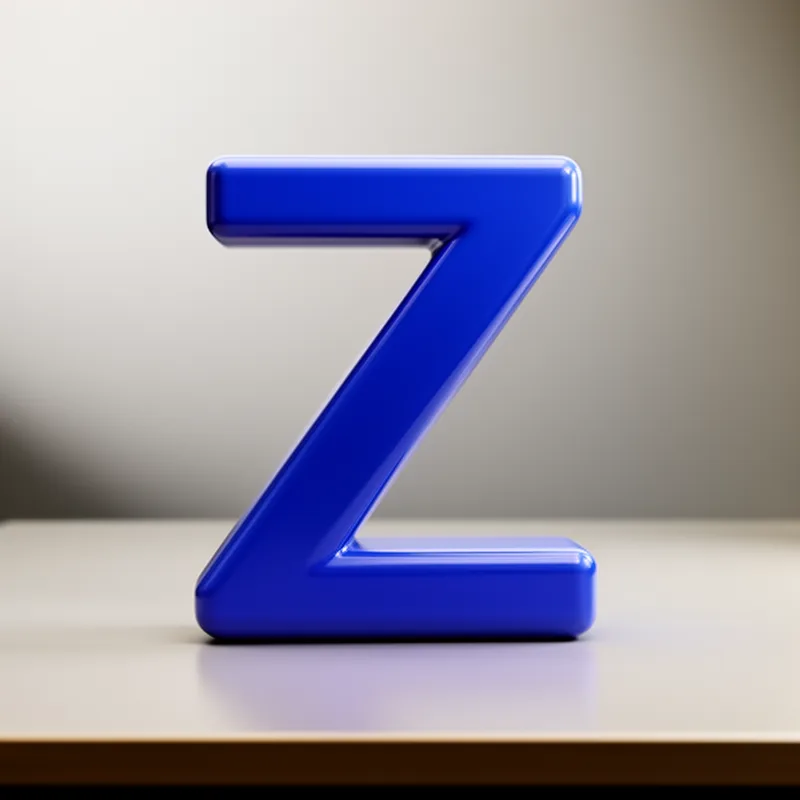
Z
 101
9.1
101
9.1

- noun
- /ziː/
- That's not a name! That's just a letter! Z, meanwhile, hits the road.
- Y and Z
- X, Y, Z
- W, X, Y, Z
Loading YouTube…
Watch on YouTubeI'm willing to pay Z amount, and Z is double X.
- I'm willing to pay Z amount, and Z is double X.
- You said I'm doing XY and Z and I'm proud of it.
Examples
-
Then, in 1983, the W and Z particles were discovered at CERN.
Academic text (1999) -
At this point, we have established that the letter Z is the note E above middle C.
Academic text (1998) -
No clear examples of particles with Z greater than 83 have been found.
Academic text (1990) -
The stimuli are P, T, C, B, D, V, Z, key, knee, and me.
Academic text (2012) -
I'll mobilize the whole Z-Patrol to stop you.
-
Your contact is Z
-
In the English alphabet, the last letter is Z.
-
Can you write the letter Z in cursive for me?
-
The word 'zebra' begins with the letter Z.
Synonyms
 37
9.9
37
9.9
The name Americans use for the letter Z
 26
9.9
26
9.9
The name British people use for the letter Z
 18
6.8
18
6.8
The last letter of the English alphabet


 1
9.9
1
9.9
An old name for the letter Z in English
A Scottish name for the letter Z in the alphabet
Compounds

- Specialized
A way of bending paper to make a zigzag shape like an accordion, often used in brochures and maps
Surface Forms
Etymology
Z comes from the Greek name zeta, and the older British name 'zed' stayed close to that original while American English later changed it to 'zee' to match letter names like 'bee' and 'cee'. That's why children may learn to end the alphabet with 'zed' or with 'zee' depending on where they grow up.