
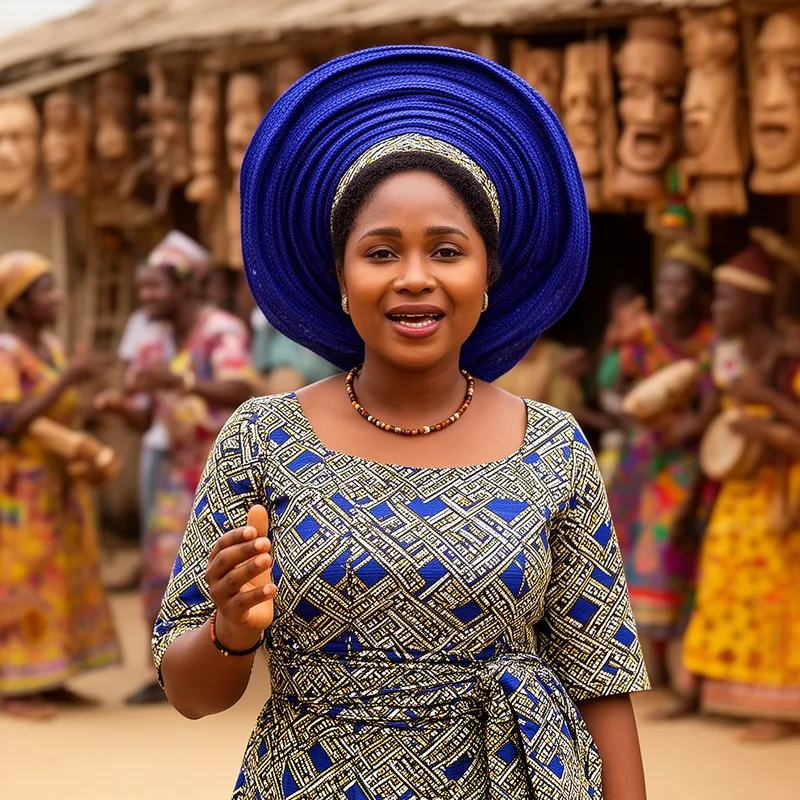
Yoruban


 1
8.1
- noun
- /jɔːˈruːbən/
- This process of species replacement, in turn, was facilitated by the Yoruban biological system of classification, which stressed sensory attributes like taste and smell as opposed to floral characteristics.
Examples
-
The Yoruban community in the United States celebrates its rich culture through traditional music and dance.
-
On arrival in the New World, Yoruban religious leaders found themselves in a totally alien cultural environment.
Academic text (1990) -
You know what she said... ...to the Yoruban interpreter today?
-
Reduced in number from the Yoruban pantheon, these deities early assumed the names but not the identities of Roman Catholic saints.
Academic text (1990) -
Once in New Orleans, West Indian religious dance practices merged with those from Yoruban, Congolese, and Dahomean descendants who were forcefully migrated to the city.
Academic text (2012) -
Many of the slaves came from well-tutored, upper-class Yoruban families; included among them were priests, mediums, and healers, some of whom were afforded much respect by other slaves and, in a few instances, even by slave owners.
Academic text (1990) -
Yoruban captives came to dominate the urban landscape in Salvador not only numerically but also culturally (Rodrigues 1977, 215-217).
Academic text (1990) -
Many Yoruban people maintain their cultural practices even while living in other countries.
-
As a Yoruban speaker, she often participates in community events that promote her language and heritage.
Synonyms
 5
6.5
A person from a West African ethnic group mainly in southwest Nigeria and nearby areas
Surface Forms
Morphology
Yoruban = Yoruba (transparent) = Yoruba + an
Nominal/adjectival formation from the ethnonym 'Yoruba' with the demonymic suffix '-an', yielding a person or adjective relating to the Yoruba.
Etymology
Yoruban comes from the name Yoruba, the people of West Africa, plus the ending -an meaning 'from' or 'person from', so a Yoruban is someone who belongs to or speaks the language of the Yoruba people.