

Wisteria frutescens
- noun
- /wɪˈstɪəriə fruːˈtɛsɛnz/
- Specialized
- Botanists recommend Wisteria frutescens for native plant gardens because of its resilience and beauty.
Examples
-
Unlike the Asian wisteria, Wisteria frutescens is less invasive and better suited to North American climates.
-
The Wisteria frutescens blooms beautifully in spring.
-
The Wisteria frutescens in her garden bloomed with clusters of delicate, pale purple flowers.
-
Have you seen the Wisteria frutescens at the botanical garden?
-
The garden was filled with beautiful blooms of Wisteria frutescens in shades of pale purple and lilac.
-
In early spring, the fragrant flowers of Wisteria frutescens attract many bees and butterflies.
-
Many homeowners love to train Wisteria frutescens to climb trellises for added charm and shade.
Synonyms

 4
7.4
4
7.4

A climbing plant with hanging purple or white flowers grown for decoration
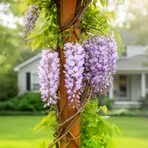
A climbing plant with pale purple flowers that grows in the eastern United States

A climbing plant with hard stems and pale lilac flowers that grows in the eastern United States
Surface Forms
Morphology
wisteria + frutescens
This is a binomial scientific name combining the genus 'Wisteria' with a specific epithet; a learner who knows 'wisteria' can readily infer it denotes a particular kind or species of that plant. Although 'frutescens' is a Latin epithet (not a common English word), the genus+epithet pattern is standard cross-linguistically, so the overall meaning 'a species of wisteria' is transparently derivable.
Etymology
The plant name Wisteria frutescens may come from an American doctor named Wistar who loved plants, and the second part frutescens comes from Latin and means 'shrubby'. So the name helps you remember this is a smaller, shrubby wisteria with pale purple flowers native to the eastern United States.