
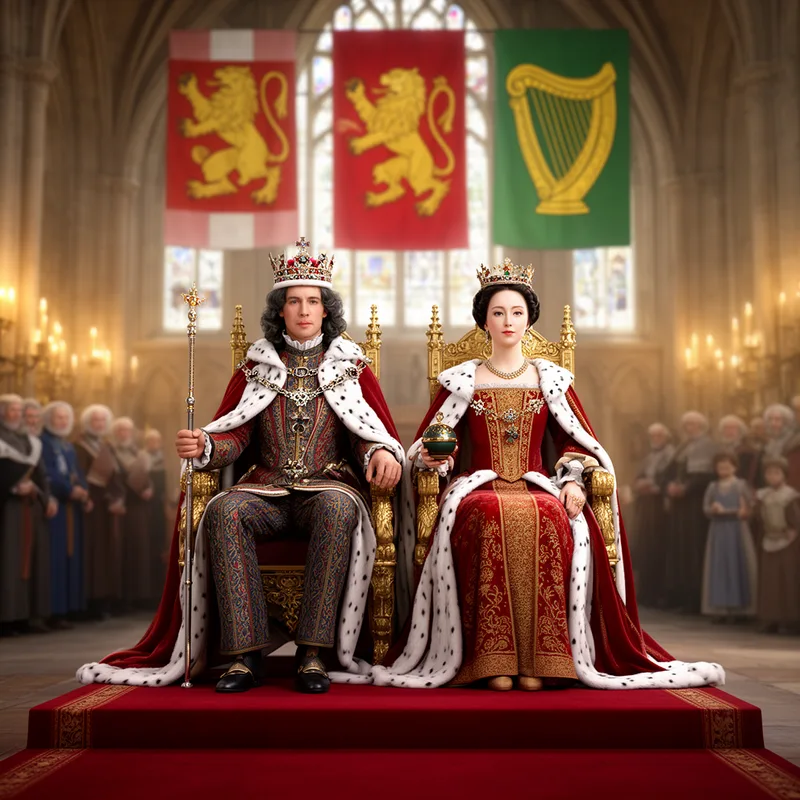
William III
 2
5.8

- proper noun
- History books often discuss the reign of William III and his significant role in shaping British monarchy.
Examples
-
William III and Mary II were crowned as joint sovereigns after the Glorious Revolution.
-
Many supporters of Protestantism welcomed the arrival of William III to the English throne.
-
The reign of William III marked a significant shift in parliamentary power in Britain.
-
William III ruled England during a time of great change.
-
Did William III really support the Bill of Rights?
-
William III ruled England, Scotland, and Ireland alongside Mary II after their ascension to the throne in 1689.
-
The legacy of William III includes significant changes in governance following the Glorious Revolution.
Synonyms
 1
8.2
King of England, Scotland and Ireland who ruled with Mary II after the Glorious Revolution
Surface Forms
Morphology
William + III
This is compositional: the personal name 'William' combined with the Roman numeral 'III' (three) yields 'William the Third' — a specific person/ordinal. The ordinal naming convention for rulers is cross-linguistically common, so a learner who knows the constituents will readily infer it refers to the third William (typically a monarch), even if they don't know historical details.
Etymology
William III was a Dutch prince who came to England with his wife Mary during the 'Glorious Revolution' and became king with her. People remember him because he agreed to share power with 'Parliament', so kings had less control.