
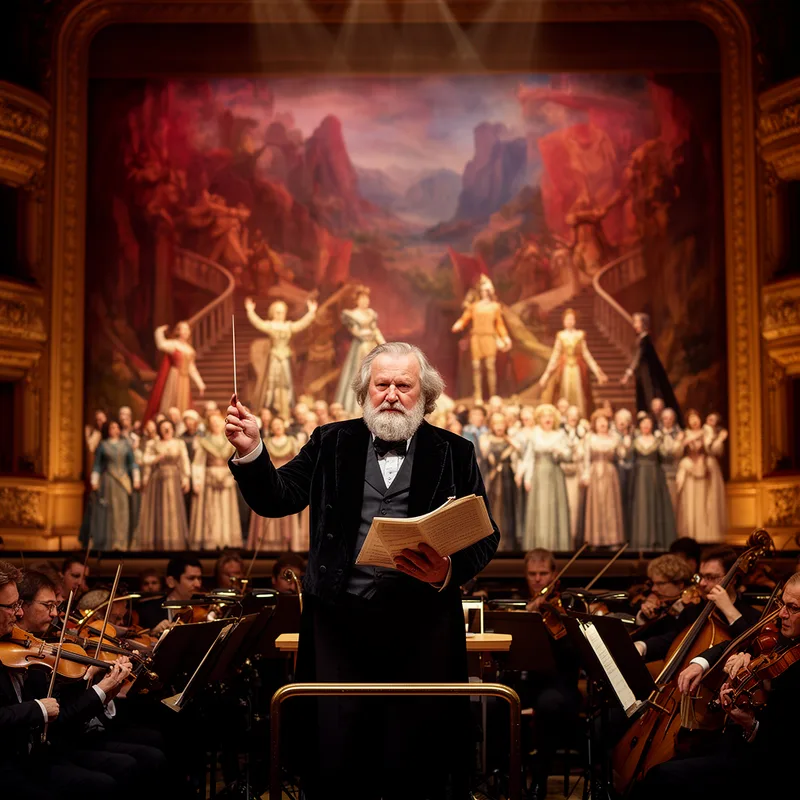
Wilhelm Richard Wagner


 1
8.1
- proper noun
- /vɑːɡnər/
- Wilhelm Richard Wagner revolutionized opera with his concept of the Gesamtkunstwerk, or ‘total work of art’.
Examples
-
Many music enthusiasts travel to Bayreuth to experience the works of Wilhelm Richard Wagner in the theatre he designed.
-
The operas of Wilhelm Richard Wagner continue to influence composers and artists today.
-
Wilhelm Richard Wagner was a revolutionary composer in the 19th century.
-
Many consider Wilhelm Richard Wagner the father of modern opera.
-
Wilhelm Richard Wagner revolutionized opera with his concept of the Gesamtkunstwerk, or 'total work of art.'
-
Many music enthusiasts travel to Bayreuth to experience the works of Wilhelm Richard Wagner in the theatre he designed.
-
The operas of Wilhelm Richard Wagner continue to influence composers and artists today.
Synonyms
 21
7.1
A German composer known for long operas that mix music and drama
 2
6.7
A German composer who wrote famous operas that mix music, drama, and stage effects
Surface Forms
Morphology
Wilhelm + Richard + Wagner
This is a personal name, not a compositional phrase; knowing the individual words 'Wilhelm', 'Richard' and 'Wagner' does not allow a B1 learner to infer the biographical meaning (a 19th‑century German composer). Proper names are arbitrary labels and their associated facts (profession, dates, significance) are cultural knowledge rather than the product of combining constituent meanings, so the expression is not derivable from its parts.
Etymology
Wilhelm Richard Wagner wrote huge, dramatic operas that join music, story, and stage action into one whole work. He even built a special theatre in Bayreuth to show them, so his name now stands for powerful, dramatic music and the idea of a 'total work of art'.