
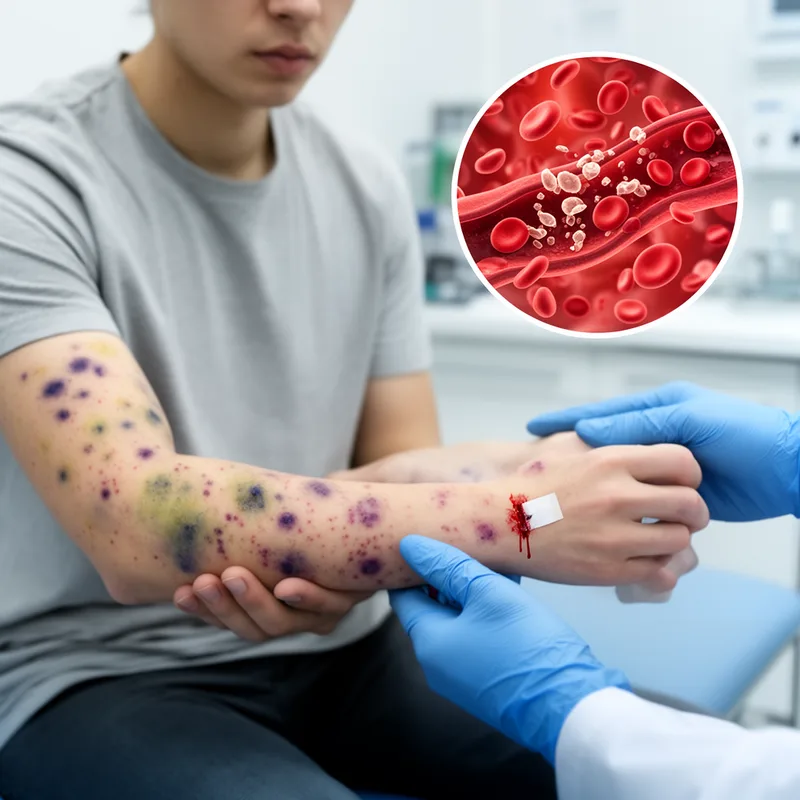
Werlhof's disease
- noun
- /ˈwɜrˌlɒfs dɪˈziːz/
- Specialized
- The patient was diagnosed with Werlhof's disease after presenting symptoms of unexplained bruising and bleeding.
Examples
-
Treatment options for Werlhof's disease often focus on increasing platelet counts and managing bleeding risks.
-
Patients with Werlhof's disease often experience easy bruising.
-
Early recognition of Werlhof's disease can significantly improve patient outcomes.
-
My friend was diagnosed with Werlhof's disease last year.
-
The patient was diagnosed with Werlhof's disease after presenting symptoms of unexplained bruising and bleeding.
-
Early recognition of Werlhof's disease can significantly improve patient outcomes.
-
Treatment options for Werlhof's disease often focus on increasing platelet counts and managing bleeding risks.
Synonyms

Purple spots or bruises on the skin caused by low blood platelets
A condition that causes easy bruising and bleeding because the blood has very few platelets for no known reason
Widespread bleeding into the skin and inside the mouth when blood cells that stop bleeding are low
Surface Forms
Morphology
Werlhof's + disease
This is opaque because the first element is an eponym/proper name ('Werlhof's') that carries no descriptive meaning a learner can interpret, while 'disease' only signals a medical disorder in general. A B1 learner who knows the words would not be able to infer the specific condition (purpura, low platelets, easy bruising) from the constituents. Eponymous medical names are language- and culture-specific and therefore non-compositional for meaning derivation.
Etymology
Werlhof's disease is named after an 18th-century doctor called Werlhof who first wrote about people with strange bruises and bleeding. Because he described the problem of 'few blood platelets' and easy bleeding, his name became the label for that condition and so the term now refers to that disorder.

