
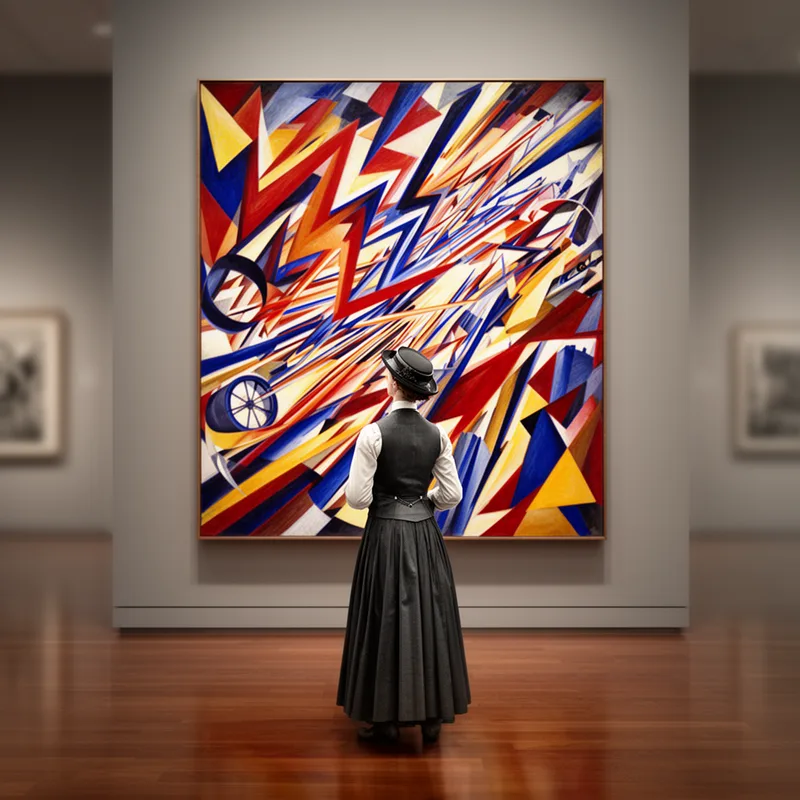
Vorticist


 1
9.9
- adjective
- /ˈvɔrtɪsɪst/
- Literature
- The artist's latest work captures the Vorticist style with its bold geometric shapes and energetic lines.
Examples
-
When he left London for the western front in 1917, he was already famous, or notorious, as the author of the novel Tarr, the editor of the provocative magazine BLAST (the first English periodical to publish Eliot), and the leading Vorticist painter, a colleague of the Vorticist American poet, Pound.
Academic text (2001) -
The city loomed up then fell back from us at odd angles, as if it had achieved the topological values of a Vorticist painting.
Fiction book (1994) -
Critics praised the exhibition for showcasing the vibrant Vorticist aesthetics of the early 20th century.
-
Many Vorticist artists were influenced by the dynamic changes in urban life during the industrial era.
Surface Forms
Morphology
Vorticist = Vorticism (opaque) = vortic + ist
The term 'Vorticist' is derived from 'Vorticism', a specific art movement, which may not be apparent without prior knowledge.
Etymology
Vorticist comes from the word vortex, which means 'whirl' or 'whirlpool', and the ending -ist that shows a style or kind. Think of sharp lines and turning energy like a whirlpool, so Vorticist describes art that looks bold, abstract and full of motion.