
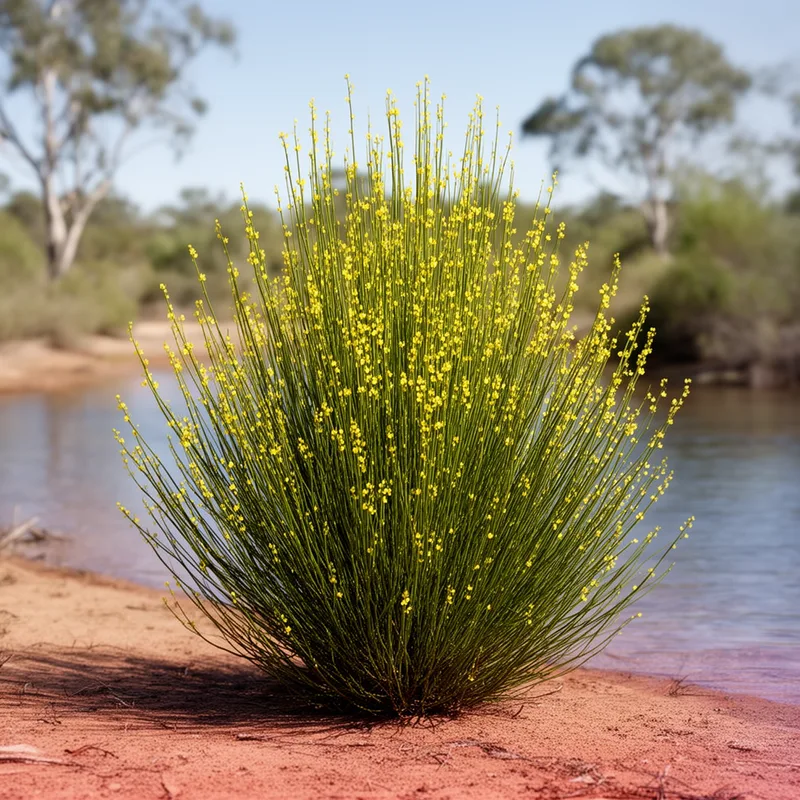
Viminaria juncea
- noun
- Specialized
- The Viminaria juncea is well-known for its leafless appearance and vibrant yellow flowers.
Examples
-
The Viminaria juncea adds a splash of yellow to the Australian bushland in spring.
-
In its natural habitat, Viminaria juncea thrives along the banks of waterways.
-
Gardeners often plant Viminaria juncea for its distinctive shape and drought resistance.
-
The Viminaria juncea is often found in arid regions of Australia.
-
I saw a beautiful Viminaria juncea blooming in the garden.
-
In springtime, the Viminaria juncea fills the landscape with bright yellow blooms, attracting local pollinators.
-
Many Australian gardeners choose Viminaria juncea because it is drought-resistant and requires minimal maintenance.
Surface Forms
Morphology
Viminaria + juncea
This is a scientific Latin binomial (genus + species) rather than a compositional English phrase. The constituents are specialized/unknown (one is a botanical genus and the other is not a standard English word), so a B1 learner who knows the listed constituents would not be able to derive the meaning ‘an Australian leafless shrub’ from them. Understanding requires domain-specific or Latin taxonomic knowledge, making the expression idiomatic to scientific nomenclature and not transparently interpretable by general learners.
Etymology
Viminaria juncea may come from old Latin words: vimen for a thin, bendy twig and juncea for a rush or reed. These images match the Australian shrub's long, thin stems and broom-like shape, so the name points to how it looks and explains the common name 'native broom'.

