
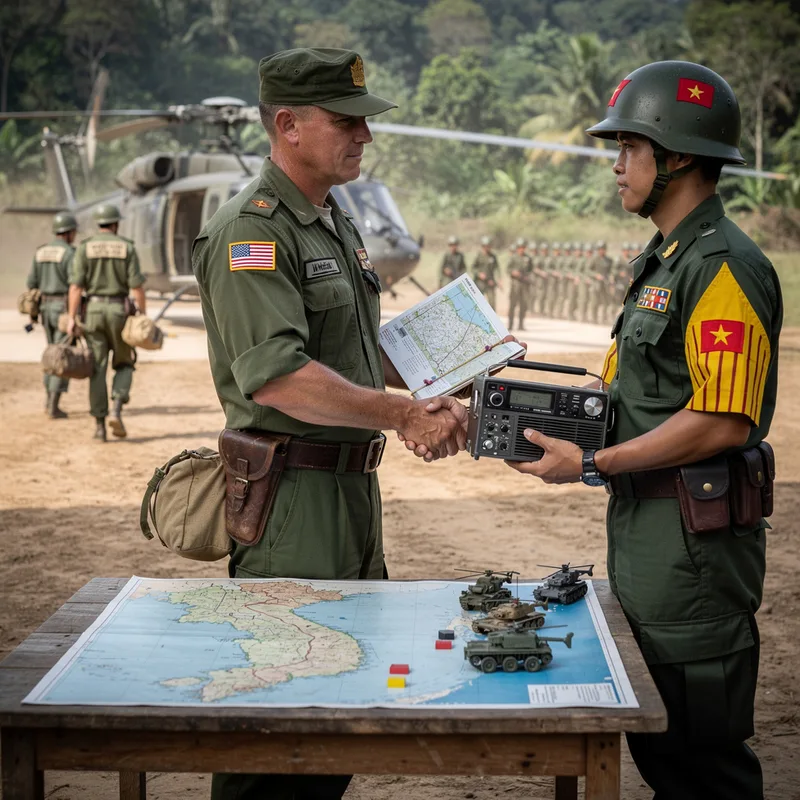
Vietnamization
 1
9.3

- noun
- /ˌviːɛt.nəˈzeɪ.ʃən/
- Many historians debate the effectiveness of Vietnamization in reducing American military involvement in the war.
- Vietnamization of the war
Examples
-
The policy of Vietnamization aimed to hand over military operations to South Vietnamese forces.
-
They were working with the locals to train them as part of the Nixon "Vietnamization" plan.
Blog text (32) -
Vietnamization was in process.
Fiction book (1995) -
The failure of Vietnamization to win popular support caused an ongoing erosion of confidence in the various American but illegal Saigon regimes.
-
Nixon said that "the United States is going to encourage, and has a right to expect, that this problem of communist aggression will be increasingly handled by, and the responsibility for it taken by, the Asian nations themselves." The Nixon Doctrine, which specifically concerned Southeast Asia, was little more than a clarification of the president's policy of Vietnamization (turning the ground war over to the South Vietnamese) and had no lasting impact.
Academic text (1991) -
Only temporizing, middling policies—first, surreptitious escalation, then "Vietnamization"—that postponed the hard choice were within political bounds.
Academic text (2000) -
The concept of Vietnamization became a significant strategy during Nixon's presidency, focusing on supporting South Vietnamese troops.
Surface Forms
Morphology
Vietnamization = Vietnamize (semi-transparent) = Vietnam + ize + ation
Formed from 'Vietnam' + productive verb-forming '-ize' and nominalizing '-ation', but sense 1 refers to a specific historical policy, making the full meaning specialized rather than purely compositional for an average learner.
Etymology
Vietnamization comes from Vietnam and the ending -ization, which means 'making or becoming'. It was used for a policy that tried to 'make' the war run by South Vietnamese forces instead of U.S. soldiers, so it means 'handing over control' in a military sense.