
Victory Day


 1
3.4
1
3.4
- noun
- Victory Day celebration
- Victory Day parade
Loading YouTube…
Watch on YouTubeThat got a lot of coverage because I somehow timed it on the Victory Day of Bangladesh.
- That got a lot of coverage because I somehow timed it on the Victory Day of Bangladesh.
- And at the same time as you've got this, you add Zelensky, who released a video saying we won on Victory Day.
Examples
-
That got a lot of coverage because I somehow timed it on the Victory Day of Bangladesh.
-
A maid in the hotel had found him close to noon on Saturday, Victory Day, when she entered the suite to make the bed and tidy up the room.
Fiction book (1996) -
What was an Argentinian citizen with an expired passport doing in Malabo on Victory Day, dressed in fancy clothes just bought at Burberry's, the store of choice of the British colony?
Fiction book (1996) -
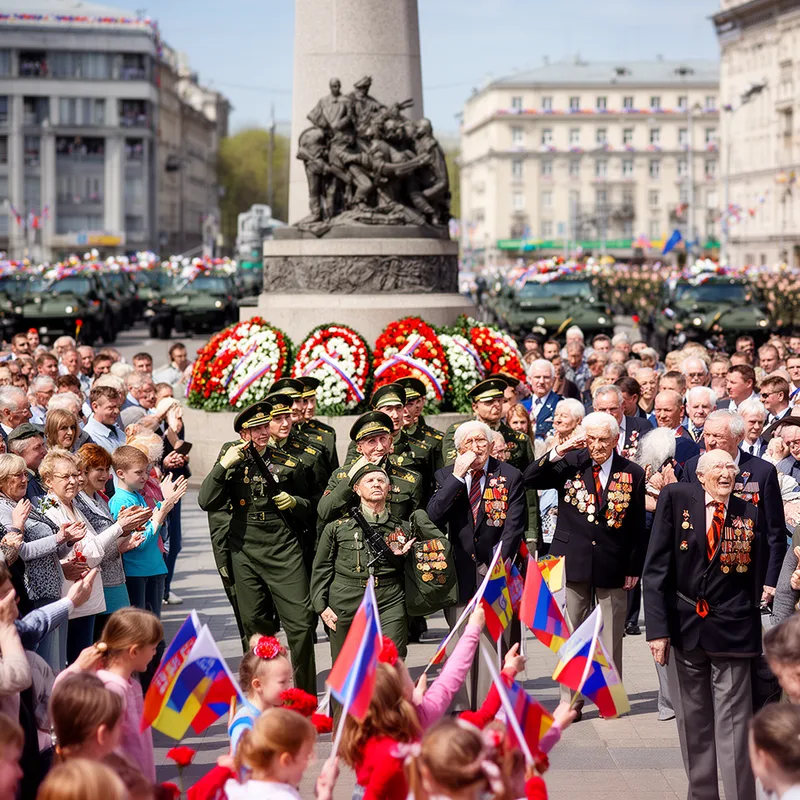
Every year, Russians celebrate Victory Day on May 9 to honor their victory over Nazi Germany in World War II.
-
Schools and community centers organize events to commemorate Victory Day, highlighting its importance in history.
-
The Victory Day parade in Moscow features military displays and honors veterans who fought in the war.
Synonyms
A day when people celebrate a victory in a war
Antonyms

Surface Forms
Morphology
The meaning 'a day set aside to commemorate a victory' is directly and transparently built from 'victory' (success in a struggle) + 'day' (a calendar day or observance), following the common English pattern 'X Day' for commemorative holidays. This construction is cross-linguistically common (e.g., Día de la Victoria, Jour de la Victoire, День Победы), so a B1 learner who knows both constituents will readily infer the meaning.
Etymology
Victory Day comes from the idea of choosing one special day to celebrate a big victory after a battle, with parades, flags and ceremonies in the streets. That's why it now means 'a day set aside to remember an important victory', often a 'public holiday'.