
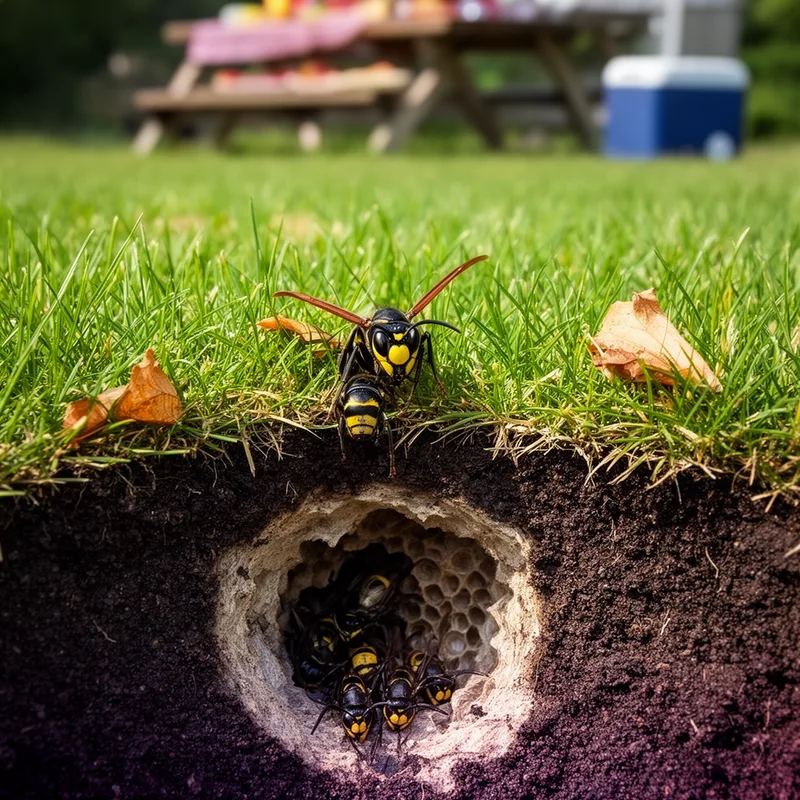
Vespula maculifrons
- noun
- Specialized
- Unlike honeybees, Vespula maculifrons typically build their colonies underground.
Examples
-
The Vespula maculifrons is often seen buzzing around picnic areas searching for food.
-
Have you seen a Vespula maculifrons nest in your yard?
-
Researchers studied the nesting behavior of Vespula maculifrons in suburban gardens.
-
The Vespula maculifrons is often mistaken for other wasp species.
-
Researchers studied the nesting behavior of Vespula maculifrons in suburban gardens.
-
The Vespula maculifrons is often seen buzzing around picnic areas searching for food.
-
Unlike honeybees, Vespula maculifrons typically build their colonies underground.
Synonyms
 1
3.6
1
3.6

A small aggressive wasp with yellow and black stripes that often builds nests in the ground
 1
4.6
1
4.6
A small aggressive wasp with yellow and black stripes that stings painfully
A small wasp with yellow marks that lives in nests in the ground
Surface Forms
Morphology
Vespula + maculifrons
This is a Latin binomial: 'Vespula' clearly marks the genus (a group of social wasps), so a learner who knows the constituents can infer it names a species of wasp. The specific epithet 'maculifrons' is a specialized Latin compound (roughly ‘spotted forehead’) and is not transparently interpretable to an average B1 learner, so the precise descriptive sense is not predictable without specialist or etymological knowledge.
Etymology
Vespula maculifrons comes from Latin words: Vespula means 'little wasp' and maculifrons means 'spotted forehead'. So the name gives a picture of a small yellow-marked wasp with a spot on its head, which fits this species that often nests in the ground.