
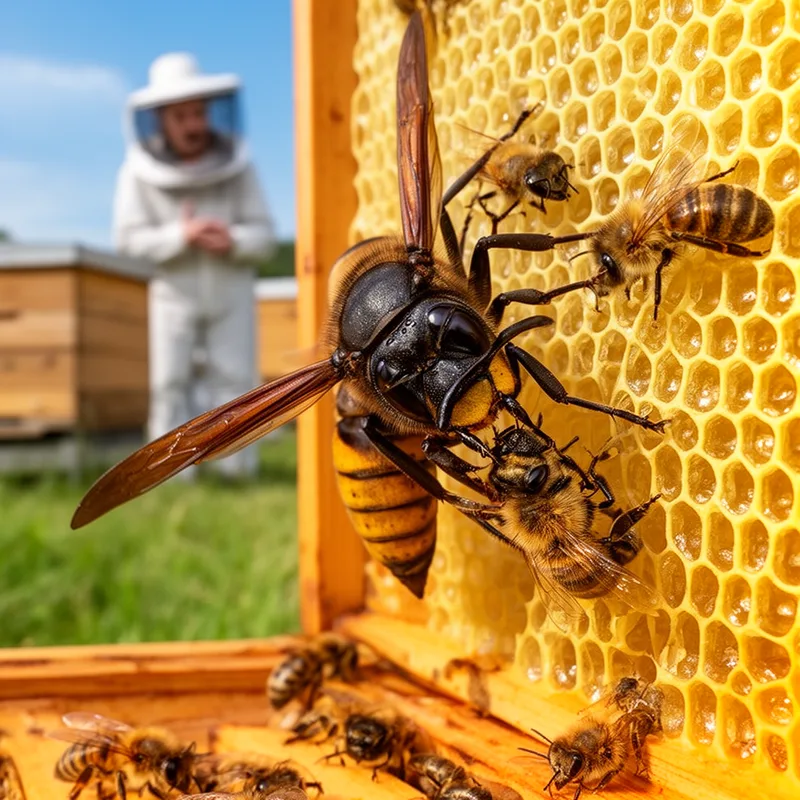
Vespa velutina


 1
9.5
- noun
- Specialized
- The arrival of Vespa velutina has caused concern among local beekeepers because it threatens honeybee populations.
Examples
-
The Vespa velutina is known to attack honeybee colonies.
-
Efforts to control Vespa velutina are underway in several European countries.
-
The arrival of Vespa velutina has caused concern among local beekeepers.
-
Scientists are studying how Vespa velutina affects native insect populations.
-
Farmers are concerned about the Vespa velutina invasion.
-
Scientists are studying how Vespa velutina affects native insect populations and ecosystems.
-
Efforts to control Vespa velutina are underway in several European countries to protect local bee colonies.
Surface Forms
Morphology
Vespa + velutina
Knowing 'Vespa' (a genus of wasps/hornets) lets a learner infer this is a kind of wasp, so there is partial compositional information. However, the species epithet 'velutina' is not a transparent English word and the specific sense (an Asian invasive hornet that preys on honeybees) cannot be derived from the parts, so the overall meaning is only partially predictable.
Etymology
Vespa velutina comes from Latin: Vespa means 'wasp' and velutina means 'velvety', giving the image of a dark, smooth-bodied wasp. So the name refers to this invasive hornet that hunts honeybees.