

Ustilago maydis
- noun
- Specialized
- Ustilago maydis infects maize, causing greyish-white swellings that eventually burst to release black spores.
Examples
-
In some Mexican cuisine, Ustilago maydis is harvested as a delicacy called huitlacoche.
-
The Ustilago maydis fungus can devastate an entire cornfield.
-
Ustilago maydis infects the ears of corn, producing swellings that later turn black and dusty.
-
Researchers are studying Ustilago maydis for its role in plant pathology and possible biotechnological uses.
-
Farmers must be vigilant against Ustilago maydis in their maize crops.
-
Farmers need to monitor their maize for signs of Ustilago maydis, which can severely affect crop yield.
-
In Mexico, Ustilago maydis is considered a prized ingredient known as huitlacoche, adding unique flavor to dishes.
Synonyms
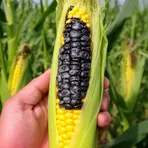
A disease that makes black swollen lumps on corn ears

A disease of corn that makes grey-white bumps burst and show black dust

A disease caused by a fungus that makes big grey growths on corn ears
Surface Forms
Morphology
Ustilago + maydis
This is a Latin taxonomic binomial rather than an English compositional phrase; the parts are proper names (one a genus label and the other not defined) and do not convey the common-language meaning 'a fungus that causes corn smut.' Taxonomic names are arbitrary and not semantically transparent to an average B1 learner, so knowing the constituent forms would not allow them to infer the MWE's meaning.
Etymology
The noun Ustilago maydis may come from old Latin words: Ustilago from a word meaning 'to burn' because the fungus makes black, soot-like patches, and maydis from the word for 'maize' meaning 'corn'. So the name points to the black fungus that grows on corn.

