

U.S. Army
 85
1.7
85
1.7

- proper noun
- /juː ɛs ˈɑrmi/
- The U.S. Army can't win without you.
- U.S. Army Corps
- U.S. Army Corps of Engineers
- U.S. Army unit
Examples
-
In the winter of 1969, an elite force of the U.S. Army was sent on a top-secret assignment in southeast Vietnam.
-
I fly helicopters for the U.S. Army in Afghanistan.
-
This is the U.S. Army.
-
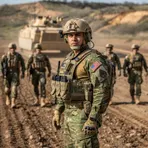
Always gives me great pride in my country... when I see such fine young men in the U.S. Army.
-
I held my last job as a secretary for the U.S. Army for exactly one year.
Fiction book (1992) -
The work is sponsored by the U.S. Army Research Laboratory.
Academic text (2011) -
A three-year tour of duty in the U.S. Army followed, which concluded with a two-year assignment in Germany.
Academic text (1993) -
He'd served in the elite of the U.S. Army, from infantry to Special Forces to a counterterrorist unit.
Fiction book (1999) -
Captain Nathaniel Lyon of the U.S. Army could hardly have seemed a less imposing warrior.
Academic text (2011) -
I fly helicopters for the U.S. Army in Afghanistan.
Synonyms
 ∞
1.3
∞
1.3
The part of the United States military that trains soldiers to fight on land
 67
4.1
67
4.1
Soldiers and army groups that fight and work on land, not in the air or at sea
 37
1.6
37
1.6
The army of the United States that trains soldiers to fight on land
 28
2.5
28
2.5
The main land force of the United States that trains and sends soldiers to fight
Surface Forms
Morphology
The meaning 'the land-based military branch of the United States' is directly derivable from combining 'U.S.' (United States) and 'Army' (land force). This referential, compositional naming pattern is cross-linguistically common and would be immediately understandable to a B1 learner who knows both constituents.
Etymology
U.S. Army comes from the parts U.S., short for the 'United States', and Army, a group of soldiers who fight on land. When the new country needed organized soldiers, this name came to mean the United States' land military force.