

Tunguska
 3
8.9
3
8.9

- proper noun
- The Tunguska River flows through a remote part of Siberia before joining the Yenisei River.
- Tunguska region
- Tunguska event
- Tunguska explosion
Examples
-
On the morning of June 30, 1908, a fireball roared over central Siberia, then burst into a mushroom cloud 20,000 feet above a desolate valley of the Tunguska River.
Academic text (1992) -
Many researchers visited the Tunguska River to study its unique ecosystem.
-
This thing fell from the sky into Tunguska Forest.
-
- Your current orbital position is above Tunguska, northern Russia.
-
Most people know about the Tunguska event that happened in Russia in 1908.
Blog text (1) -
Each fragment was at least as big as the one thought to have hit Tunguska.
Blog text (11) -
Most scientists believe that the cause of the Tunguska explosion was a comet, which actually evaporated in its travel through Earth's atmosphere.
Academic text (1992) -
On June 30, 1908, a spectacular explosion rocked the Tunguska region of Siberia, flattening 200 square kilometers of forest.
Academic text (1992) -
When authorities finally reached the desolate Tunguska River region, they found that nearly 2000 square kilometers of trees (about the size of the state of Rhode Island) had been flattened.
Academic text (1994) -
And bringing the threat closer to home, just 100 years ago, in June 1908, an asteroid or comet that was estimated at 100 to 200 feet in diameter exploded in the skies above Tunguska, Siberia.
Academic text (2008)
Synonyms
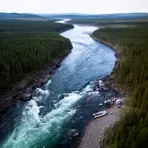
A large river in Siberia that flows northwest to join the Yenisei

A river in Siberia that flows northwest to join the Yenisei

A river in central Siberia that flows into the Yenisei River

A river in southeast Siberia that flows northwest from Lake Baikal to join the Yenisei River

A river in Siberia that starts north of Lake Baikal and flows north and west into the Yenisei River
Compounds
A river in Siberia that starts north of Lake Baikal and flows north and west into the Yenisei River
Surface Forms
Etymology
Tunguska comes from the name Tungus, which was used for the local Evenki people, so Tunguska basically means 'river of the Tungus' and is the name given to this river in Siberia.