
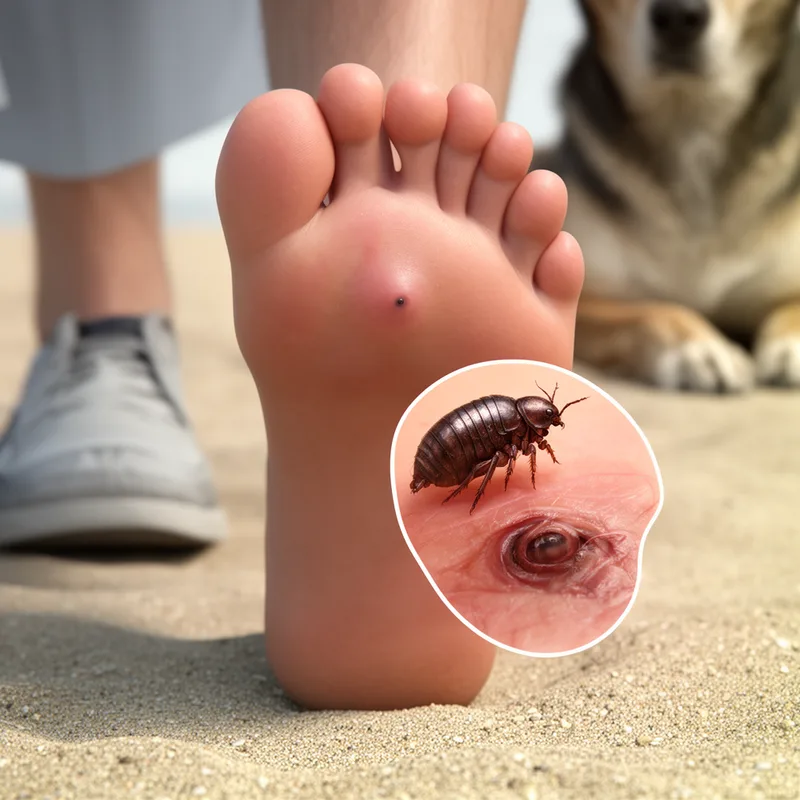
Tunga penetrans
- noun
- /ˈtʌŋə ˈpɛnɪtrənz/
- Specialized
- The infestation was caused by Tunga penetrans burrowing into the skin of bare feet.
Examples
-
Health workers explained how Tunga penetrans could be prevented by wearing shoes.
-
The Tunga penetrans is often found in sandy areas.
-
Researchers collected several specimens of Tunga penetrans for the laboratory study.
-
Have you heard about the Tunga penetrans infestation?
-
Health workers explained that Tunga penetrans burrows under the skin, causing discomfort and infection.
-
People should be cautious of Tunga penetrans when walking barefoot in tropical regions.
-
The medical team treated several cases of skin infections caused by Tunga penetrans in the local population.
Synonyms


 1
9.9
1
9.9
A very small tropical flea that buries itself under the skin and can cause serious infection

A small flea in tropical areas that burrows under the skin and causes itching or infection
Surface Forms
Morphology
Tunga + penetrans
This is a Latin binomial (a taxonomic name) rather than a regular English phrase; while 'Tunga' signals a flea and 'penetrans' resembles English 'penetrate', the second element is not an English word and the precise clinical meaning (a female that burrows under the skin) is specialised. A learner who knows the constituents might guess a relation to piercing/penetrating fleas, but the exact sense and usage function as a single proper name and are not fully predictable without prior exposure.
Etymology
Tunga penetrans is a Latin-style name where penetrans means 'penetrating' and Tunga may come from a local word for the flea. This gives a clear image: the female flea actually burrows under the skin, so the name fits the insect's behavior.