
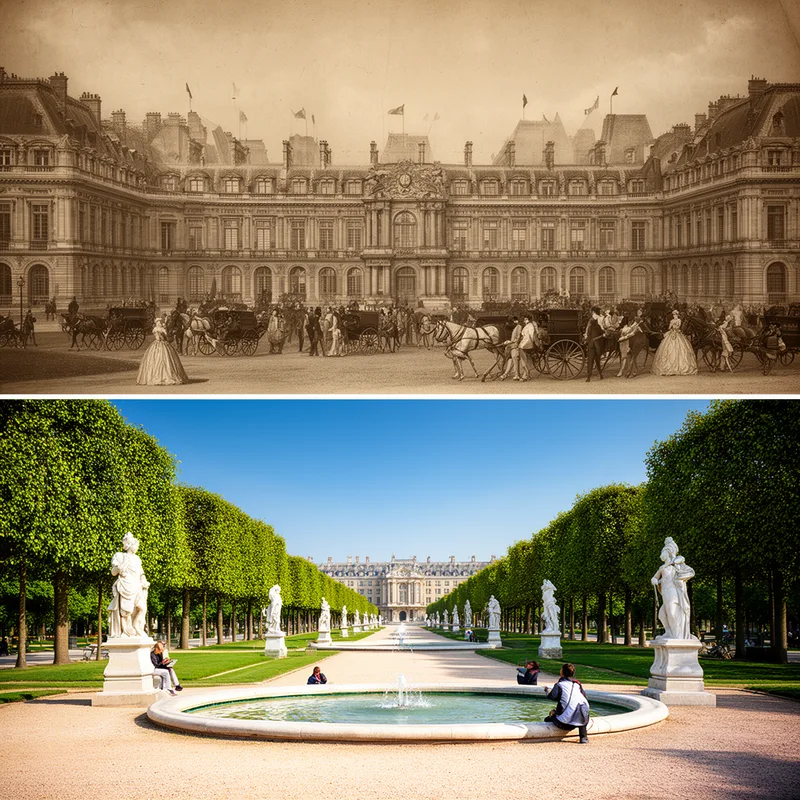
Tuileries
 1
9.9
1
9.9

- proper noun
- The Tuileries was once a magnificent royal palace in Paris, built for Catherine de Medici.
Examples
-
Through it all, he flourished at the Tuileries.
Academic text (2001) -
Anna Bicknell remembered in her account of life at the Tuileries during the Second Empire that there was such an avid struggle to outdo others, to reach a higher degree of outward display, that extravagance became universal.
Academic text (1997) -
In front of us, sir, the Tuileries Gardens.
-
The Tuileries Palace used to be in the middle of the gardens.
-
Sometimes, she imagined that she was Marie Antoinette pacing through the echoing halls of the Tuileries.
Fiction book (1993) -
Darling planned the Tuileries, the Orangerie, an afternoon at the Louvre, couscous in the Latin Quarter, and two nights at the Hotel Angleterre.
Fiction book (1996) -
In his memo, which he wrote in 1666, Perrault outlined a program of eighteen statues of royal virtues for the dome of the Tuileries.
Academic text (2001) -
At his father's death in 1637, Louis Lerambert became the official custodian of the king's collection of ancient statues at the Louvre and the Tuileries.
Academic text (2001) -
Today, only the beautiful gardens of the Tuileries remain, attracting visitors from around the world.
-
In the 19th century, the Tuileries Palace was a symbol of royal power in Paris before its destruction.
Synonyms

A former royal home in Paris built in 1564 and burned down in 1871
Compounds

Formal public gardens next to the Louvre in Paris with paths, fountains, and sculptures
Surface Forms
Etymology
Tuileries comes from the French word tuile, which means 'tile'. The royal palace was built on land where people once made roof tiles, so the palace took the name of these 'tile works', which is why it was called the Tuileries.