
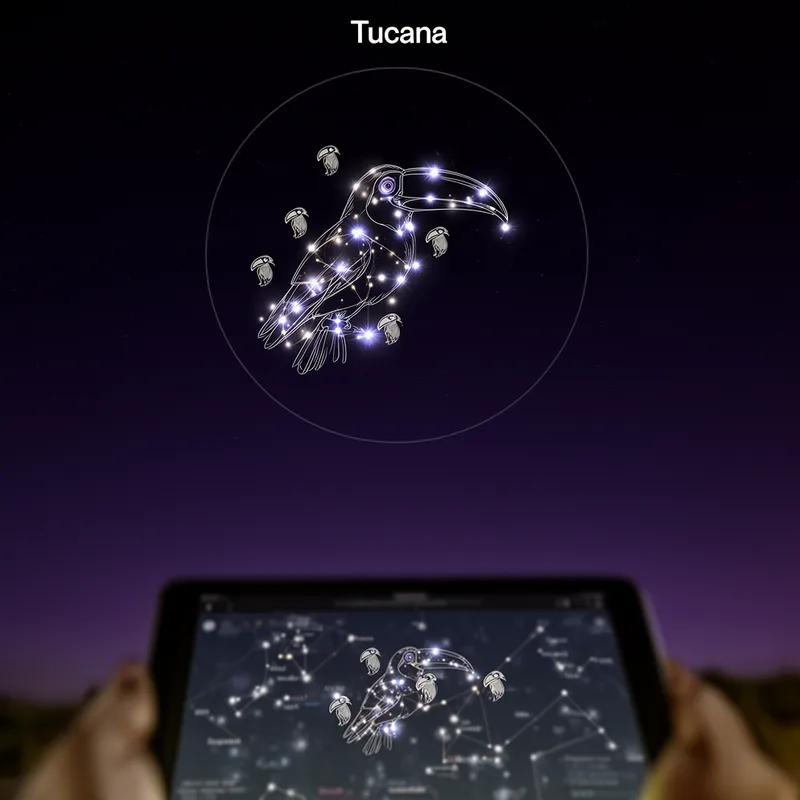
Tucanae


 1
9.9
- proper noun
- /tuːˈkeɪni/
- Specialized
- Scientists often refer to 47 Tucanae when discussing the properties of globular clusters.
- 47 Tucanae
Examples
-
The stars in the constellation are famously represented by the name 47 Tucanae in scientific literature.
-
Astronomers had studied globular clusters, including 47 Tucanae (known colloquially as "47 Tuc"), with the Hubble Space Telescope before the servicing mission.
Academic text (1994) -
30 Doradus and 47 Tucanae are the only numbered bodies in the deep southern hemisphere.
Academic text (2000) -
PHOTOS (BLACK & WHITE): The core of the globular cluster 47 Tucanae taken with Hubble's Faint Object Camera before and after servicing.
Academic text (1994) -
Lying 2 degrees to the west of the SMC is the second best globular cluster in the night sky: 47 Tucanae (NGC 104).
Academic text (2002) -
The Magellanic Clouds can be seen to the left of the Milky Way. The Tarantula Nebula is visible as a bright spot in the Large Magellanic Cloud, while the cluster 47 Tucanae appears as a bright diffuse star just next to the Small Magellanic Cloud.
Blog text (23) -
One of the most studied objects in astronomy is 47 Tucanae, a globular cluster in the southern sky.
Surface Forms
Etymology
Tucanae in star names is a Latin form used to show 'of Tucana', with the ending -ae meaning 'belonging to'. So Alpha Tucanae literally reads as 'Alpha of Tucana', which tells you the star is part of that constellation.