
Tuareg
 3
9.5

- noun
- /ˈtwɑːrɛɡ/
- Fighting between Malian government forces and Tuareg rebels broke out in the country's north in January.
- Tuareg leader
- Tuareg woman
- Many Tuareg
Examples
-
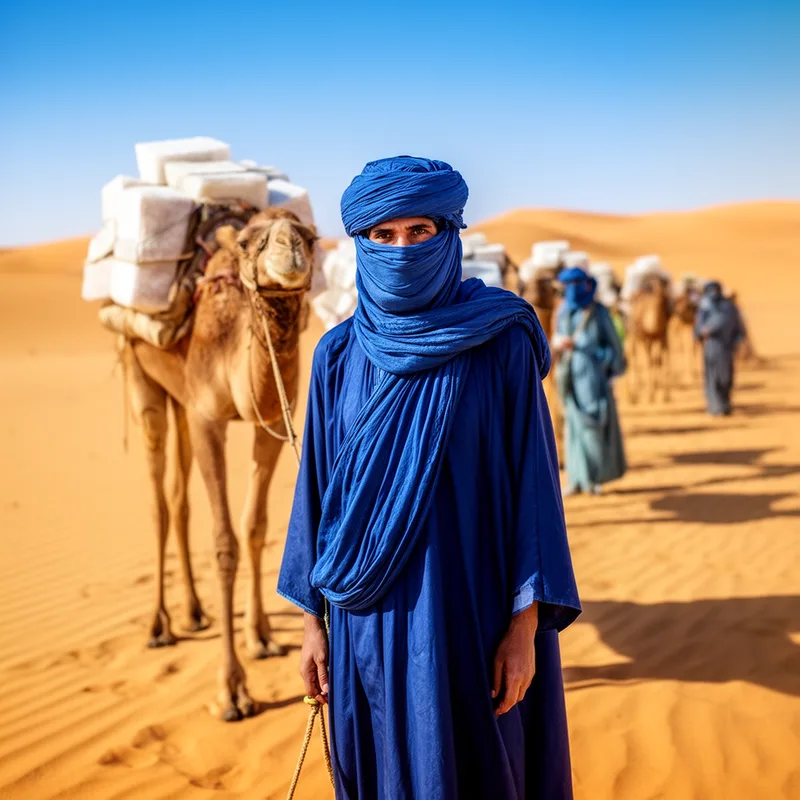
The Tuareg are known for their distinctive blue clothing and mastery of the harsh desert environment.
-
Many Tuareg people maintain a traditional nomadic lifestyle, moving across the Sahara to find water and grazing land.
-
Central here is a case study of a Tuareg international musical touring ensemble called Tartit from northern Mali.
Academic text (2005) -
Many Tuareg elders, particularly the devoutly Muslim, tend to be ambivalent toward these performances.
Academic text (2000) -
The artist has engraved classical Tuareg design motifs on the pendants, thus creating a link with earlier types of Tuareg jewelry.
Academic text (2006) -
Some Tuareg nomads in Niger, Algeria, and Libya still use it today.
Academic text (2004) -
Despite their economic independence and nomadism, most Tuareg women until recently tended to travel less widely than Tuareg men, who raided and traded over longer distances.
Academic text (2005) -
In Agadez, I stayed at the Hotel Kaosen, named for a fierce Tuareg leader who finally surrendered to the French months after the end of World War I.
Academic text (2002) -
Bruce Whitehouse: The history of Tuareg unrest and separatism goes back at least to 1963 and has recurred roughly once a decade.
Blog text (20) -
The rich culture of the Tuareg includes unique music, poetry, and intricate jewelry designs that reflect their heritage.
Synonyms


 1
9.6
A member of the Berber people of North Africa
Surface Forms
Etymology
Tuareg came into English from French Touareg, a name used in Arabic for the desert Berber people; in their own language they often call themselves Imuhagh or Kel Tamasheq, which means 'people of Tamasheq', so Tuareg today means a member of that nomadic group in the Sahara.