

Tropidoclonion lineatum
- noun
- Specialized
- The Tropidoclonion lineatum is rarely seen because it spends much of its time underground.
Examples
-
Because the Tropidoclonion lineatum feeds mostly on earthworms, its presence indicates healthy soil conditions.
-
Biologists often find Tropidoclonion lineatum in city parks during surveys of urban wildlife.
-
The Tropidoclonion lineatum is often found in city parks.
-
Have you ever seen a Tropidoclonion lineatum in the wild?
-
The Tropidoclonion lineatum is often found slithering through the grass in urban parks, where it blends well with its surroundings.
-
Due to its preference for damp environments, the Tropidoclonion lineatum can frequently be spotted near compost piles or garden beds.
-
Many people are surprised to learn that the Tropidoclonion lineatum is non-venomous and poses no threat to humans.
Synonyms
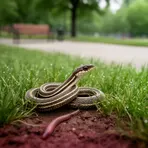
A small shy snake with stripes that lives in grass and parks in the central United States
Surface Forms
Morphology
Tropidoclonion + lineatum
This is a taxonomic binomial: if a learner knows 'Tropidoclonion' as a genus of small lined snakes they can infer the phrase refers to a particular snake species, so part of the meaning (that it is a snake) is recoverable. However, the species epithet 'lineatum' is Latin/specialist and not transparent to an average B1 learner, and scientific naming conventions are not standard English compositional patterns, making the overall expression only partially predictable.
Etymology
Tropidoclonion lineatum comes from the idea of a 'lined' snake: lineatum means thin lines running down its body. So the name gives a simple picture of a small, secretive snake with stripes that hides in soil and eats earthworms.

