
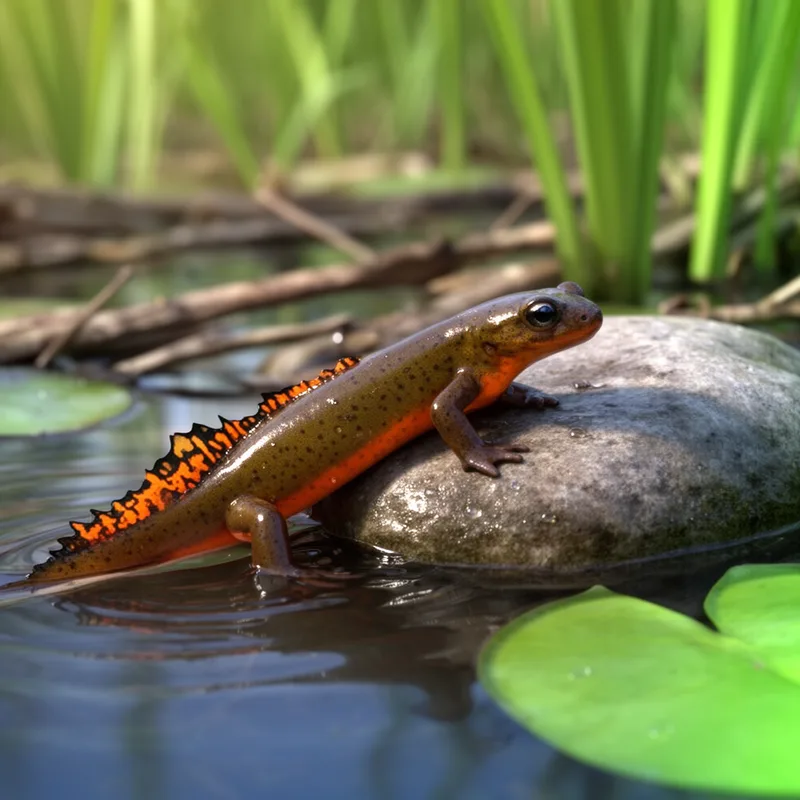
Triturus vulgaris
- noun
- Specialized
- The Triturus vulgaris is often found in ponds and wetlands across Europe.
Examples
-
During the breeding season, the male Triturus vulgaris develops a strikingly colorful crest.
-
Researchers studied the population dynamics of Triturus vulgaris in restored habitats.
-
The Triturus vulgaris is often found near ponds.
-
Have you ever seen a Triturus vulgaris in the wild?
-
The Triturus vulgaris is a small salamander commonly seen near freshwater bodies.
-
In spring, male Triturus vulgaris display vibrant colors to attract females.
-
The Triturus vulgaris can adapt to various aquatic environments, including ponds and streams.
Synonyms

 ∞
4.9
∞
4.9

A small brightly coloured animal with soft skin that lives in water and on land

A small amphibian with smooth skin that lives in ponds and wet places
Surface Forms
Morphology
The term is transparently composed of a genus name ('Triturus') and a Latin specific epithet ('vulgaris' = widespread/typical), so a learner who knows both constituents can infer it refers to the common/widespread species in that genus. Binomial taxonomic naming is a standard, cross-linguistic convention rather than an idiom, making the meaning compositional and predictable for learners familiar with the parts.
Etymology
Triturus vulgaris may come from an old name for a small newt, and the species part vulgaris is Latin for 'common'. So the full name simply means the 'common newt', a helpful memory hook for this small, smooth salamander found across Europe.