
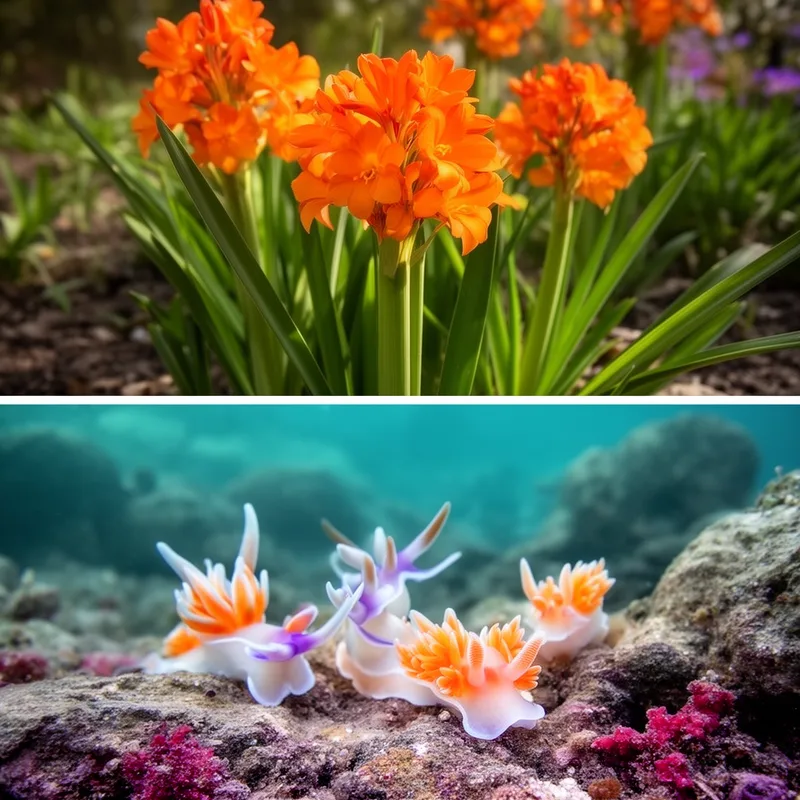
Tritonia
- proper noun
- Specialized
- Tritonia only swims in emergencies, such as to escape a predatory sea star (bottom left).
- Tritonia diomedea
- Tritonia swims
Examples
-
Not surprisingly, Tritonia's crawling speed is slow, averaging about twenty feet per hour.
Academic text (2009) -
We study the neurons controlling the swimming behaviors of two particular species of swimming slugs, Tritonia diomedea and Melibe leonina.
Academic text (2009) -
To find out, we looked at a sea slug that does swim, but in a manner different from Tritonia.
Academic text (2009) -
Does that mean that their common ancestor swam like Tritonia?
Academic text (2009) -
Tritonia, with its large, serotonin-containing DSI neurons and known neural connections, offered a tremendous opportunity to study how serotonin functions.
Academic text (2009) -
Unlike its usual ciliary crawling, Tritonia's swimming convulsions are produced by contraction of body-wall muscles.
Academic text (2009) -
The illustration sequence shows how Tritonia diomedea swims by convulsing its whole body with dorsal-ventral flexions, performing a series of jackknives and backbends.
Academic text (2009) -
The most important difference, from our perspective, is that Tritonia flexes dorsally and ventrally, while Melibe flexes its body laterally, from side to side. See illustrations on pages 38-39.
Academic text (2009) -
As described earlier, Melibe's swimming style differs significantly from Tritonia's in degree of control, length of time, and reason for initiation (Melibe sometimes swims spontaneously, not only during emergency maneuvers).
Academic text (2009) -
The scientist observed that Tritonia has a unique way of swimming to escape predators.
Surface Forms
Etymology
Tritonia probably comes from Greek, either from Triton ('sea god') or from the prefix tri- ('three'), as in triangle and trio. That helps you remember it is used for sea slugs, which fit the 'Triton' idea, and for iris-family flowers that often have parts in 'threes'.

