
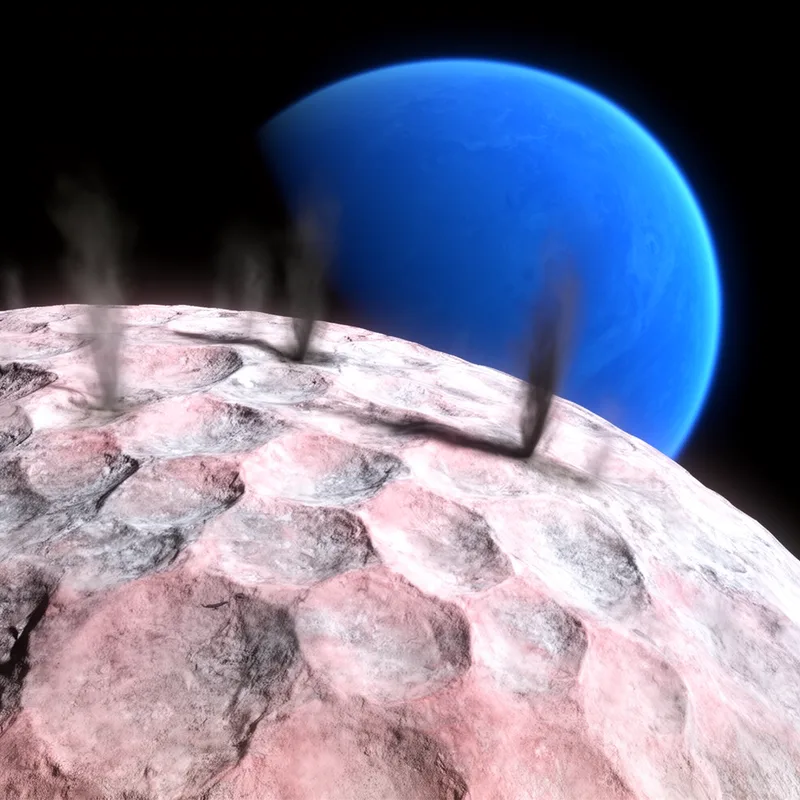
Triton
 5
7.3

The largest moon of Neptune with an icy surface and a backward orbit
- proper noun
- /ˈtraɪtən/
- Specialized
:
Tritón
- The Voyager 2 spacecraft provided stunning images of Triton and its retrograde orbit.
- Triton orbits Neptune
Examples
-
Scientists are studying the surface of Triton to understand its unique icy geology.
-
At Neptune, the large satellite Triton was revealed as the coldest known place in our solar system.
Academic text (1990) -
When Voyager 2 swept by Neptune, it was able to examine Triton, the planet's largest and most interesting moon.
Academic text (2001) -
Here's Neptune and Triton as the Voyager mission moved out into the outer solar system beyond the large planets.
-
Discovered in 1846, Triton is the largest moon of Neptune and has active geysers.
Surface Forms
Triton main
Etymology
Triton takes its name from the Greek Τρίτων, a 'sea god' who was the son of Poseidon and was pictured as half-man, half-fish. Astronomers chose this mythological name for Neptune's largest moon to link the moon to the god of the sea.