

Tringa melanoleuca
- noun
- Specialized
- The Tringa melanoleuca can be identified by its long yellow legs and loud, clear calls.
Examples
-
Researchers tracked the movements of Tringa melanoleuca to study the effects of habitat loss.
-
During the summer, the Tringa melanoleuca can often be seen wading in shallow waters while searching for food.
-
Birds such as the Tringa melanoleuca inhabit wetlands across North America during migration season.
-
Look at that Tringa melanoleuca!
-
The Tringa melanoleuca is often seen near wetlands.
-
With its long yellow legs, the Tringa melanoleuca stands out among other shorebirds along the coast.
-
Many birdwatchers eagerly await the arrival of the Tringa melanoleuca in the wetlands each spring.
Synonyms
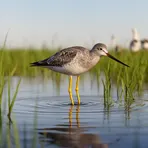
A large shorebird with long yellow legs and a long thin bill that wades in marshes
Surface Forms
Morphology
Tringa + melanoleuca
This is a Latin scientific (binomial) name, not a compositional English phrase; a B1 learner who knows the parts would not be able to infer the common name 'greater yellowlegs' from 'Tringa' and the unattested element 'melanoleuca'. Taxonomic Latin labels are referential and language-specific, and the second element is not a common English morpheme, so the meaning is not transparently derivable from the constituents.
Etymology
Tringa melanoleuca may come from older names: Tringa was an old word for a small shore bird, and melanoleuca means 'black and white'. That's why the name paints a simple picture of a wading bird with dark and light feathers, which helps you remember it's a large North American shorebird with long yellow legs.

