
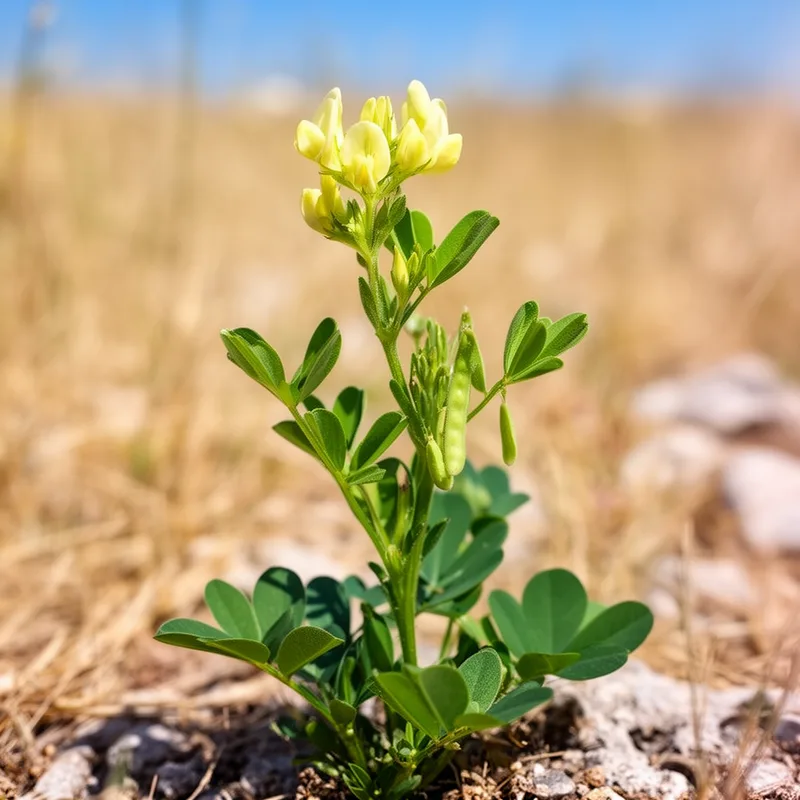
Trigonella ornithopodioides
- noun
- Specialized
- The leaves of Trigonella ornithopodioides resemble those of its relative, fenugreek.
Examples
-
Trigonella ornithopodioides is often found in Mediterranean meadows and grasslands.
-
Botanists study Trigonella ornithopodioides because of its unique seed and flower characteristics.
-
The herb Trigonella ornithopodioides is often used in traditional medicine.
-
Can you identify Trigonella ornithopodioides among other herbs?
-
Trigonella ornithopodioides grows abundantly in Mediterranean regions, thriving in well-drained soils.
-
Trigonella ornithopodioides is known for its distinctive yellow flowers that attract various pollinators.
-
In Mediterranean climates, Trigonella ornithopodioides is often found alongside other native herbs in lush meadows.
Surface Forms
Morphology
Trigonella + ornithopodioides
This is a Latin binomial (scientific species name) rather than a normal English phrasal expression; its parts are specialist taxonomic/Greek-Latin morphemes that a B1 learner will not reliably know or use to infer 'an Old World herb of the pea family.' Even if some roots (e.g. ornitho-, -oides) are recognizable to advanced learners, species epithets function as labels and require domain knowledge, so the overall meaning is not derivable from the constituents for an average learner.
Etymology
Trigonella ornithopodioides comes from old Greek and Latin words: Trigonella means 'little triangle' and ornithopodioides means 'like a bird's foot'. So the name paints a picture — the plant's leaves or seed pods look like tiny triangles or a bird's foot, which is why it got this name.

