
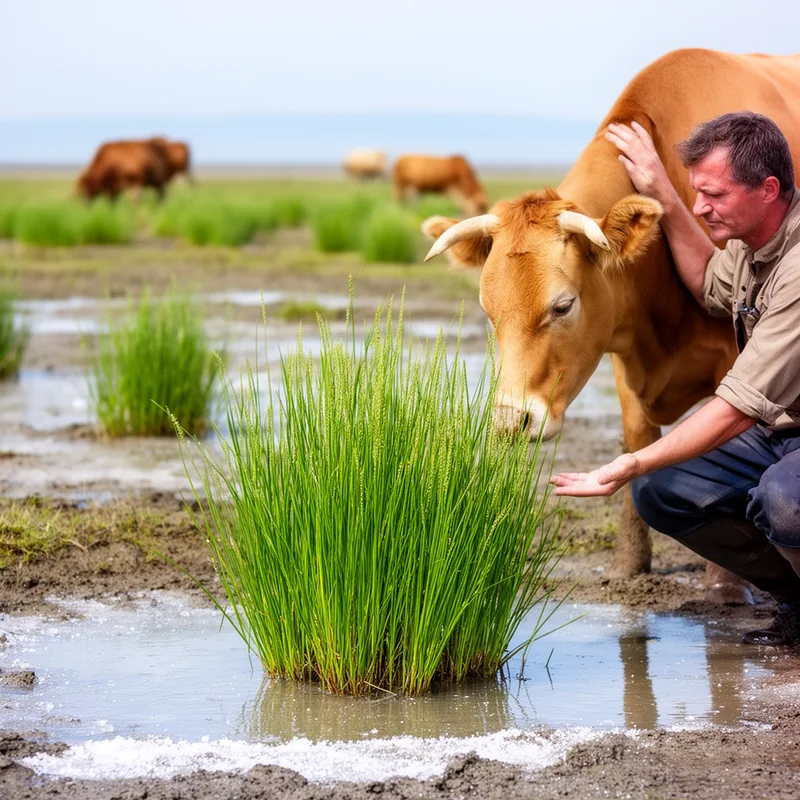
Triglochin maritima
- noun
- Specialized
 :
Triglochin maritima
:
Triglochin maritima
- Triglochin maritima grows abundantly in coastal marshes and other saline habitats.
Examples
-
Triglochin maritima can be recognized by its tufted appearance and preference for shallow, saline water.
-
Farmers are cautious of grazing their cattle near fields where Triglochin maritima is prevalent.
-
Botanists study Triglochin maritima to understand its adaptation to wet, salty environments.
-
The Triglochin maritima grows abundantly along the marshes.
-
Farmers are cautious about Triglochin maritima because it can be toxic.
-
Triglochin maritima is often found in wetlands, where its unique habitat allows it to thrive.
-
Farmers must monitor their herds to prevent them from grazing on Triglochin maritima, which can be harmful.
Synonyms
A plant that grows in shallow water or marshes and can poison farm animals
Surface Forms
Morphology
Triglochin + maritima
This is a scientific binomial combining the genus name 'Triglochin' (arrowgrass) with the Latin adjective 'maritima' meaning 'of the sea' or 'maritime', so a learner who knows both constituents can infer 'sea arrowgrass' or 'Triglochin that grows by the sea.' The meaning is compositionally derived following common species-naming patterns, making it transparent to learners who know the parts.
Etymology
Triglochin maritima comes from old words: Triglochin points to 'three points' and maritima means 'by the sea'. This gives a simple image — a grass-like plant with a three-point seed head that lives in salty marshes, which is why people call it 'sea arrowgrass' today.

