
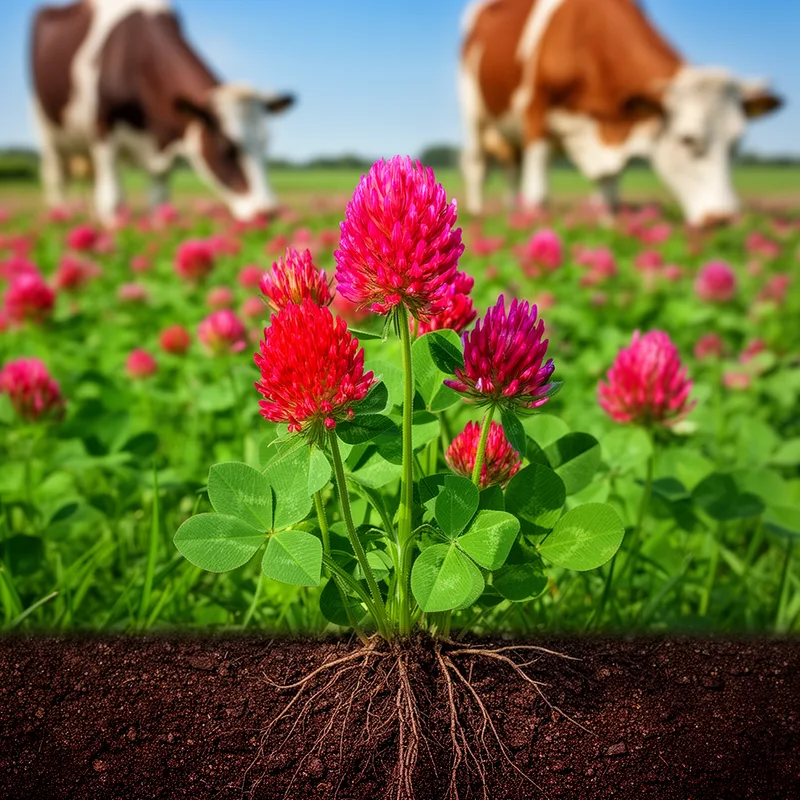
Trifolium pratense
- noun
- Specialized
- The meadow was filled with the pink blooms of Trifolium pratense.
Examples
-
Farmers sow Trifolium pratense in their fields because of its high value as livestock feed.
-
Farmers often plant Trifolium pratense for its nitrogen-fixing properties.
-
Trifolium pratense is often used as a cover crop to improve soil fertility.
-
The field was covered in Trifolium pratense.
-
Trifolium pratense is commonly used in agriculture to enhance soil health and provide forage for livestock.
-
In early summer, fields bloom with the striking pink flowers of Trifolium pratense, attracting numerous pollinators.
-
Many farmers appreciate Trifolium pratense for its ability to enrich the soil and serve as a nutritious feed for their animals.
Synonyms

 1
2.7
1
2.7

A short plant with red-purple flowers that farm animals eat and helps make soil richer
A plant with purple to pink flowers that farmers grow for animal food and to make soil better
Surface Forms
Morphology
Trifolium + pratense
The genus name 'Trifolium' directly signals 'clover', so a learner who knows that constituent would infer this is a type of clover; however 'pratense' is a Latin epithet (not listed) and is not transparently understood by a B1 learner, so the precise sense ('red clover' or 'meadow-associated') is not predictable. Scientific binomials are internationally used, which helps learners infer 'a species of clover', but the specific common-name meaning and details require botanical or Latin knowledge.
Etymology
Trifolium pratense is a Latin name that describes the plant: Trifolium means 'three-leaf' and pratense means 'meadow', because the clover has three-part leaves and grows in fields. That's why the name refers to the common 'red clover', the pink-purple flowered plant farmers grow to 'feed animals'.