
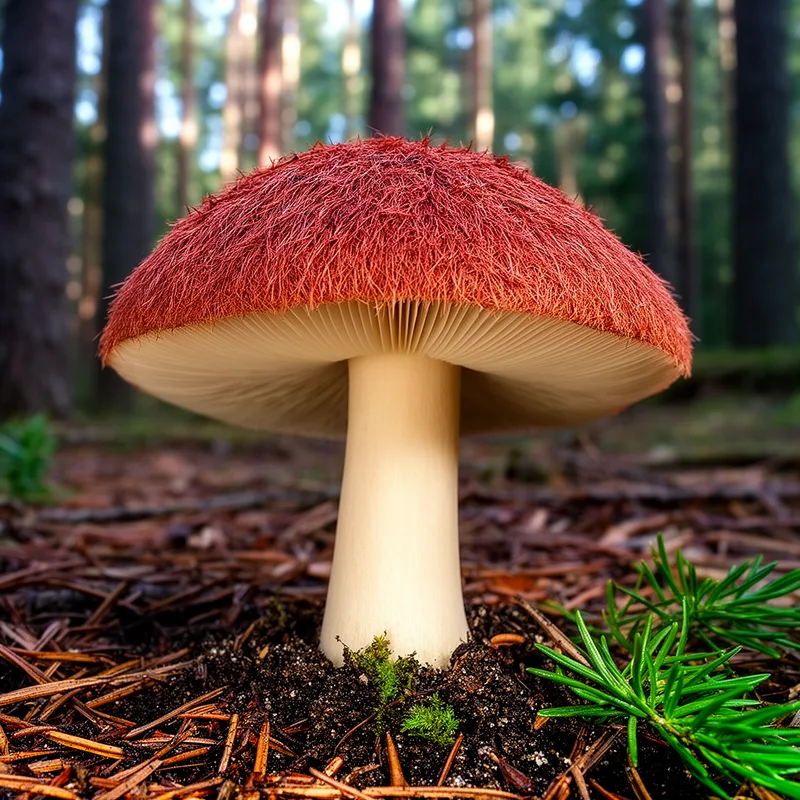
Tricholoma vaccinum
- noun
- Specialized
- The cap of Tricholoma vaccinum is easily recognized by its reddish, hairy surface.
Examples
-
Tricholoma vaccinum is commonly found growing under pine and spruce trees in northern forests.
-
Some mushroom hunters caution against eating Tricholoma vaccinum due to its questionable edibility.
-
The Tricholoma vaccinum is often found in coniferous forests.
-
Have you ever seen a Tricholoma vaccinum in the wild?
-
Tricholoma vaccinum is often sought after by mushroom enthusiasts in coniferous forests across the northern regions.
-
The distinctive reddish fibers on the cap of Tricholoma vaccinum make it easier to identify among other mushrooms.
-
In northern coniferous forests, Tricholoma vaccinum can be found growing in clusters beneath pine trees.
Surface Forms
Morphology
Tricholoma + vaccinum
This is a Latin binomial name: knowing 'Tricholoma' (a genus of mushrooms) would allow a learner to infer it names a type of mushroom, but 'vaccinum' is not an English lexical item and provides no clear, accessible meaning to a B1 learner. The precise morphological description (reddish fibrils, pale gills/stalk) cannot be derived from the constituents, so the name is only partially transparent — recognizable as a species label but not fully interpretable.
Etymology
Tricholoma vaccinum comes from old Greek and Latin: Tricholoma means 'hairy fringe', a clear picture for the mushroom's hairy, reddish cap. The word vaccinum may mean 'of cows' in Latin because the brown-red colour reminded early namers of cowhide, so the name describes a hairy, cow-coloured mushroom.

