
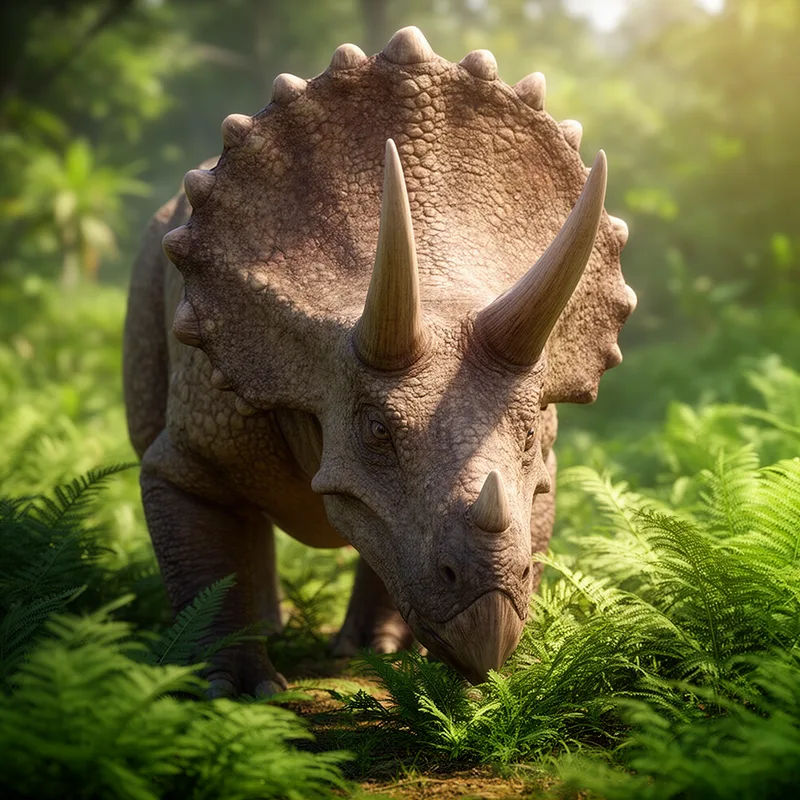
Triceratops
 1
6.9

- noun
- /traɪˈsɛrətɒps/
- Specialized
- Restorers will use the conserved Triceratops bones as patterns for molds, but when parts are missing or mismatched, mirror images will fill in.
- Triceratops bones
- Triceratops skull
Loading YouTube…
Watch on YouTubeAnd so do you think a a do you think a Triceratops would be afraid of AT Rex?
- And so do you think a a do you think a Triceratops would be afraid of AT Rex?
- Now these both have the same mass as it happens, the elephants and this and the triceratops and.
- It was a they, they don't know what it was, but they found that a sort of a graveyard of Triceratops, South Dakota.
- It was a they, they don't know what it was, but they found a sort of a graveyard of Triceratops in South Dakota.
Examples
-
A computer rendering (right) looks almost as realistic as the Triceratops specimen (left) that stood in Dinosaur Hall.
Academic text (2000) -
The museum is having casts made of bones from real Triceratops back feet and plans to send them out for scanning.
Academic text (2000) -
The museum believes it was the first Triceratops ever mounted.
Academic text (2000) -
Some of the bones in the Triceratops are as long as 54 inches.
Academic text (2000) -
As a result, in the new exhibit, the Triceratops will stand straighter on its front legs.
Academic text (2000) -
Besides the large bones of the skeleton, he also scanned an extra Triceratops skull and the skull of a related type of dinosaur called Centrosaurus.
Academic text (2000) -
The skeleton of a Triceratops on display shows its distinctive three facial horns.
-
Paleontologists discovered a well-preserved Triceratops fossil during their excavation.
-
Children were excited to learn about the Triceratops at the dinosaur museum.
Surface Forms
Morphology
Triceratops = tri + cerat + ops
Although the name can be analysed into Greek combining forms (tri- 'three', cerat- 'horn', -ops 'face'), it is a Latinized scientific name rather than a productive English formation, so learners cannot reliably derive its meaning from the parts.
Etymology
Triceratops comes from Greek parts tri- 'three', cerato- 'horn' and -ops 'face'. So the name means 'three-horned face', which helps you remember the dinosaur with three horns and a large bony frill.