

Tragelaphus strepsiceros
- noun
- Specialized
- The Tragelaphus strepsiceros is renowned for its striking spiral horns and impressive leaping ability.
Examples
-
Researchers observed several Tragelaphus strepsiceros grazing quietly in the African savanna.
-
Conservation programs are in place to protect the habitat of the Tragelaphus strepsiceros.
-
The Tragelaphus strepsiceros is known for its impressive twisted horns.
-
Have you ever seen a Tragelaphus strepsiceros in the wild?
-
Researchers observed several Tragelaphus strepsiceros grazing quietly in the African savanna.
-
The Tragelaphus strepsiceros is renowned for its striking spiral horns and impressive leaping ability.
-
Conservation programs are in place to protect the habitat of the Tragelaphus strepsiceros.
Synonyms

 1
8.6
1
8.6

A large African antelope with twisted horns and white body stripes
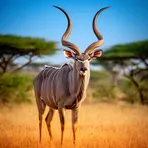
A large African antelope with long spiral horns and white stripes on its body

A large African antelope with long twisted horns and white stripes

A large African antelope with long twisted horns
Surface Forms
Morphology
The phrase is a Linnaean binomial (genus + species), so a learner who recognises both constituent forms as taxonomic names can infer it refers to a particular animal species rather than a literal compositional meaning. However, the exact identification as the 'greater kudu' and its distinctive features are not directly derivable from the Latin names without background in taxonomy or specific lexical knowledge, so the relation is only partially transparent.
Etymology
Tragelaphus strepsiceros may come from old Greek words: Tragelaphus joins 'goat' and 'deer' because the animal looks a bit like both, and strepsiceros means 'twisted horn' to describe its spiral horns. So the name fits the greater kudu, a large antelope known for its long, spiralled horns.