
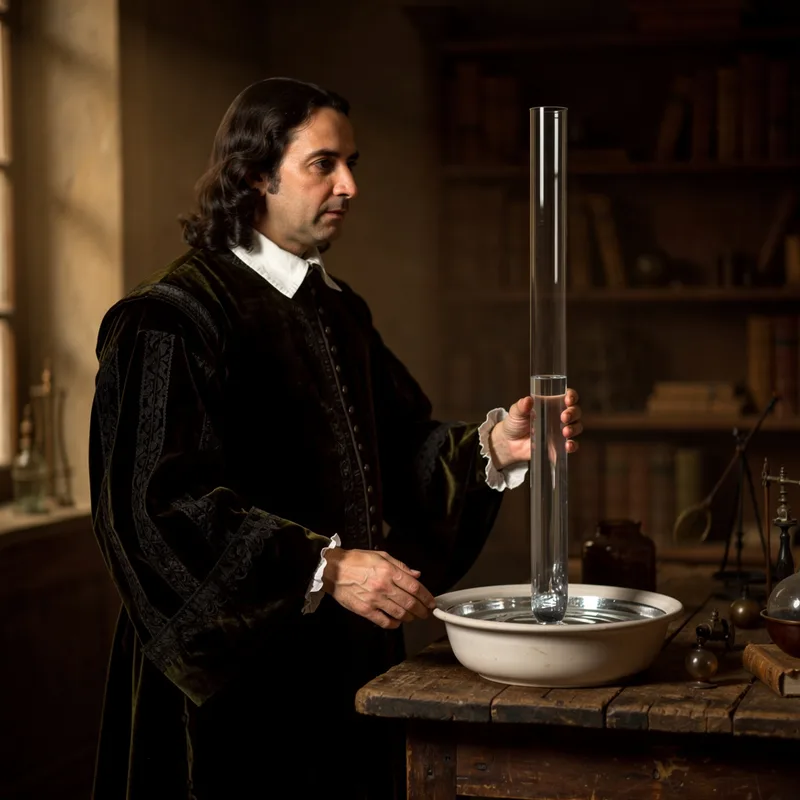
Torricelli


 1
9.9
- proper noun
- /tɔːrɪˈtʃɛli/
- The physicist Torricelli is celebrated for his contributions to fluid dynamics in the 17th century.
- Evangelista Torricelli
Examples
-
In his studies, Torricelli demonstrated that air has weight, contributing to our understanding of atmospheric pressure.
-
Torricelli, with one of the flashes of intuition that advance science at a single leap, concluded in 1643 that air must have weight.
Academic text (2003) -
Torricelli had undertaken his investigations at the suggestion of his mentor, Galileo, who was puzzled because water could not be siphoned beyond 32 feet.
Academic text (2003) -
Torricelli's hypothesis was investigated by Blaise Pascal in 1647, who conducted mountain climbing experiments to study the ramifications of the discovery.
Academic text (2003) -
In December 1992, shortly after the passage of his Cuban Democracy Act, which tightened the embargo against the island, Congressman Robert G. Torricelli (D-N.J.) assured Americans that Castro would fall within weeks.
Academic text (1996) -
Evangelista Torricelli invented the mercury barometer, which revolutionized weather forecasting.
Surface Forms
Etymology
Torricelli comes from the Italian part torre ('tower') plus the small ending -celli, so the name can mean 'little towers' or 'from the towers'. A helpful way to remember the scientist Torricelli is to picture him in a tower watching the sky and measuring air pressure with his mercury barometer, because he is famous for that invention.