
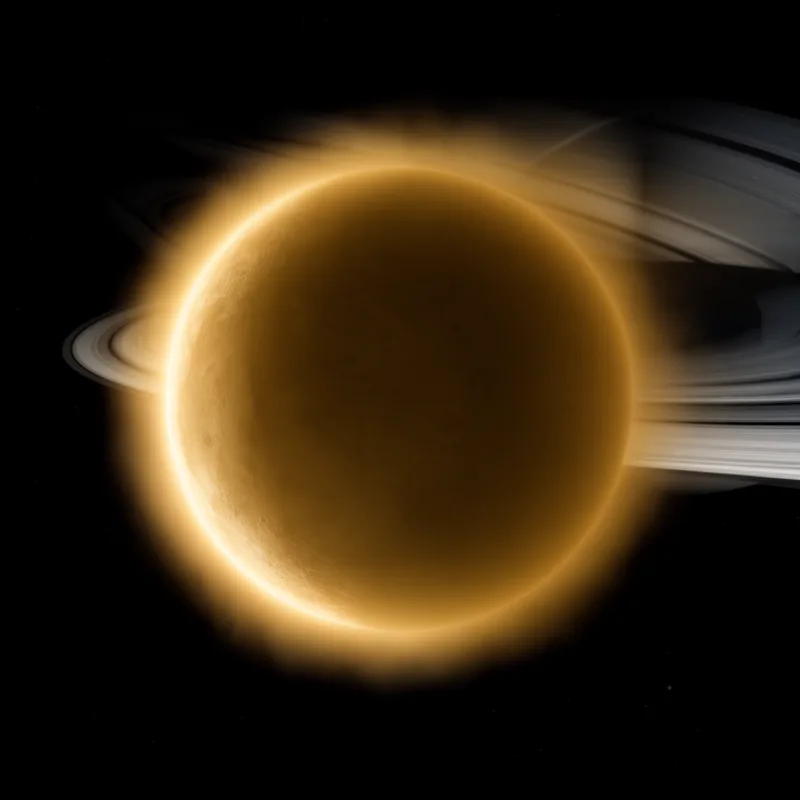
Titan
 46
7.0
46
7.0

- proper noun
- /ˈtaɪtən/
- Specialized
- Another intriguing feature of Titan's atmosphere is its apparent similarity to the atmosphere of the early Earth.
- Titan's atmosphere
- Saturn's moon Titan
- the moon Titan
Loading YouTube…
Watch on YouTubeIt's cold as all bejesus on Titan, but if you can, it's.
- It's cold as all bejesus on Titan, but if you can, it's.
- This is Saturn as viewed from Titan.
- It's called Titan, and that liquid is methane and Ethan.
Examples
-
The exploration of Titan offers a glimpse into the complex chemistry that could be present on other celestial bodies.
-
Scientists believe that the lakes and rivers of methane found on Titan are similar to bodies of water on Earth.
-
What's Titan like this time of year?
-
At the time, little information could be gleaned, aside from the fact that Titan was fairly large.
Academic text (2004) -
At the temperature and pressure measured for the surface of Titan, methane is likely to be a liquid.
Academic text (2004) -
So the moon Titan of Saturn has oceans of liquid methane.
-
Huygens will reach Titan on January 14, parachuting through the dense atmosphere for nearly three hours.
Academic text (2004) -
In January, the Huygens probe landed on Titan and discovered that liquid methane flows across the frigid surface.
Academic text (2005) -
NASA's Cassini spacecraft collected detailed images and data about Titan, revealing its dense atmosphere and surface features.
Compounds

- Specialized
A very large tropical plant with a huge flower that smells like rotten meat when it blooms
Surface Forms
Etymology
Titan for the moon comes from the Greek name Titān, the giant gods of old. The moon was given this name because it is very large and has a thick, hazy atmosphere, so the name brings to mind something 'giant' and 'powerful'.