
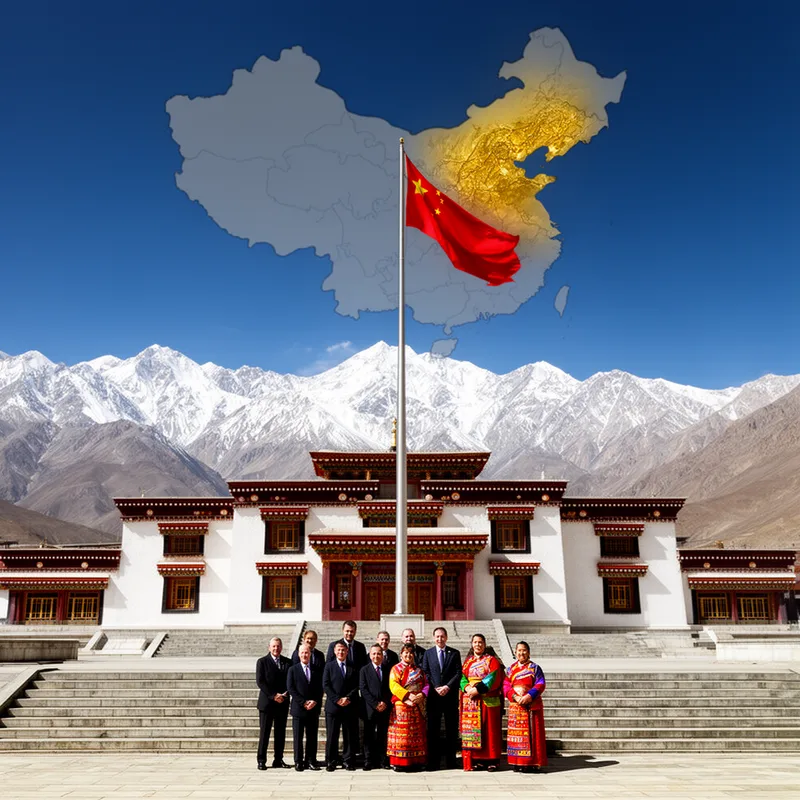
Tibet Autonomous Region
- proper noun
- The Tibet Autonomous Region has its own local government under the framework of Chinese law.
Examples
-
Many travelers visit the Tibet Autonomous Region to experience its unique culture and breathtaking mountain scenery.
-
The Tibet Autonomous Region is home to breathtaking landscapes and a rich cultural heritage.
-
Environmental concerns have become prominent in the Tibet Autonomous Region due to its fragile ecosystem.
-
The Tibet Autonomous Region is famous for its stunning landscapes.
-
Many tourists visit the Tibet Autonomous Region each year.
-
Many travelers seek to explore the unique customs and traditions of the Tibet Autonomous Region.
-
The Tibet Autonomous Region, nestled in the Himalayas, is known for its stunning monasteries and high-altitude lakes.
Synonyms
 121
4.7
121
4.7

A region in China high in the Himalayas known for Buddhist culture and high flat land
A region of China in the Himalayas also called Tibet

An older spelling of Tibet, the high mountain region in China
Surface Forms
Morphology
Tibet + autonomous + region
The phrase is a straightforward composition: 'Tibet' (place) + 'autonomous' (self-governing) + 'region' (area), so a learner who knows the constituents can infer it denotes a self-governing area in Tibet. Administrative naming of regions is common cross-linguistically (e.g. Spanish/French equivalents), which supports immediate comprehension by a B1 learner.
Etymology
Tibet Autonomous Region is the official name for the part of Tibet that was given a special regional status. The word autonomous means 'able to run its own local government', so the name points to the high, mountain area of Tibet with its own local leaders within China.