
Themis
 1
9.9

- proper noun
- Specialized
- If one observer of any of the four observers in the experiment observes and measures electric fields and electric currents within the body of plasma, then that is the reality, such as the THEMIS experiments already conducted.
- THEMIS Imaging System
Examples
-
Coronal mass ejections (CMEs) have been observed and measured in this way by THEMIS, and all the above parameters have been detected and measured.
Blog text (14) -
And, if so, would the Svalgaard hypothetical satellite observer, at the same time and location as THEMIS made its observations, detect no electric fields and electric currents?
Blog text (14) -
And this said onboard THEMIS and the gamma ray spectrometer.
-
There is only one reality, one set of physical conditions, at the location and time where the two satellite probes intersect, even though the THEMIS satellite has a different "reference frame" due to its different vector direction and speed.
Blog text (14) -
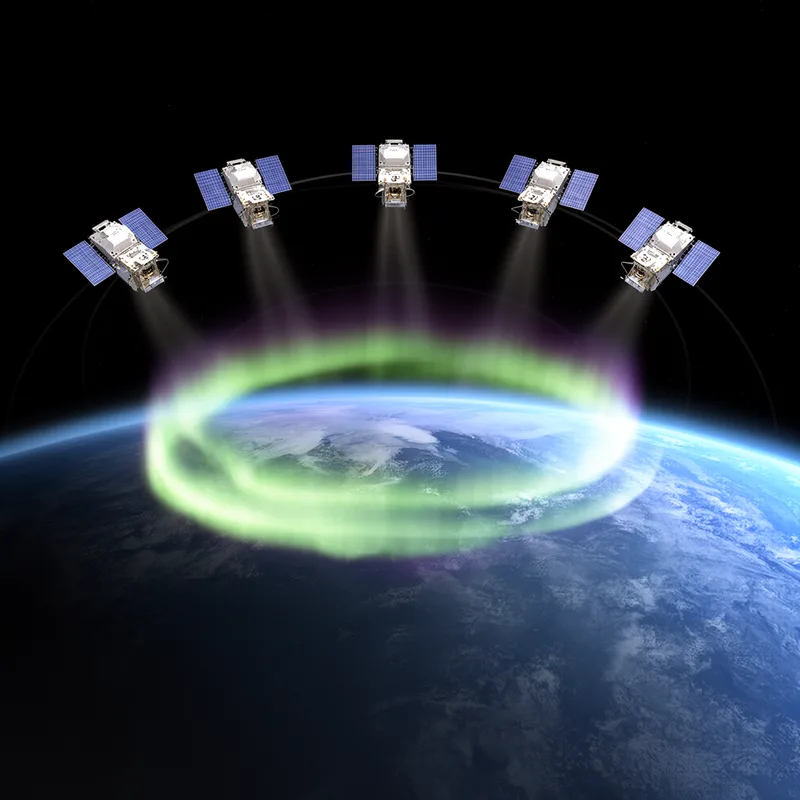
The THEMIS array of multiple satellite probes collects raw data as it intercepts the body of plasma it's set to observe and measure, then the scientists analyze and interpret the collected raw data.
Blog text (14) -
But does that rationale apply to the solar wind, as Dr. Svalgaard claims: such that there are no electric fields or electric currents for the hypothetical Svalgaard observer, even though, at the same time and place, THEMIS would be able to detect electric fields and electric currents.
Blog text (14) -
Another observer is located on the Earth, another at L1 (a position between the Sun and the Earth that provides stability for the observing platform, in situ satellite), and in multiple coordinated satellites such as THEMIS, which move through and by the body of plasma collecting data in situ.
Blog text (14) -
The THEMIS spacecraft collects data on magnetospheric substorms every four days.
-
Scientists use data from THEMIS to study the interactions between solar winds and Earth's atmosphere.
-
The THEMIS mission has significantly advanced our understanding of space weather phenomena.
Surface Forms
Etymology
Themis was used as the name for a NASA mission because it comes from the Greek goddess of 'law' and 'order', and the satellites look for patterns in space storms. That name reminds you that the mission is trying to find rules and order in chaotic space weather.