
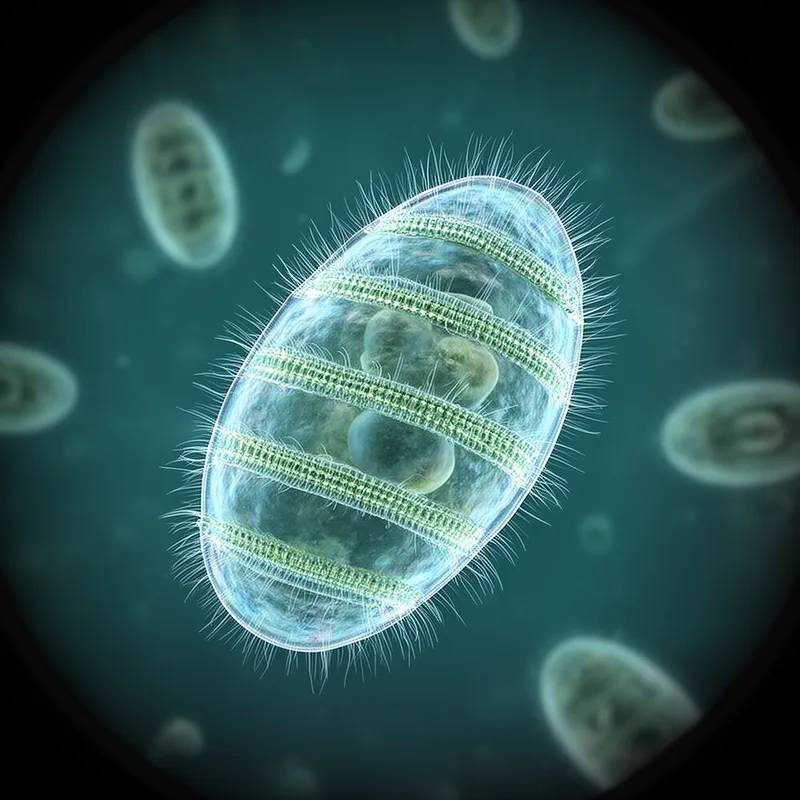
Tetrahymena
- noun
- /ˌtɛtrəˈhaɪmɪnə/
- Specialized
- When the Tetrahymena ribozyme cuts a nucleic acid, it retains a bit of the target molecule, and that bit serves as a tag, identifying successful ribozymes.
- Tetrahymena ribozyme
Examples
-
A living system in which to explore telomere behavior came in the form of the ciliated protozoan Tetrahymena thermophila.
Academic text (1998) -
In the lab, researchers used Tetrahymena to study the effects of environmental changes on algae growth.
-
Beaudry and Joyce asked if the Tetrahymena ribozyme could cut DNA instead of its usual RNA.
Academic text (1993) -
"The first thing that these experiments told us," Joyce says, "is that Darwin was right -- not that we had doubts." Although it is terribly inefficient, Joyce reports that the wild-type Tetrahymena ribozyme does cleave DNA.
Academic text (1993) -
The genus Tetrahymena is often utilized in experiments to understand cellular processes.
-
Scientists frequently reference Tetrahymena for its role in genetic research due to its unique cellular structure.
Surface Forms
Morphology
Tetrahymena = tetra + hymena
Tetrahymena is a scientific genus name formed from Greek combining elements; these parts are not productive standalone English words for learners and the specialized taxonomic meaning is not inferable from the components.
Etymology
Tetrahymena comes from Greek parts tetra- meaning 'four', the same tetra- you see in tetrahedron, and -hymena meaning 'membrane'. It was named for the tiny single-celled creatures' four thin, membrane-like parts that look like hairs, so the name helps you remember they have 'four' special hair-like structures.

