
Tethys
 1
9.9

- proper noun
- Literature
- Aristotle analyzed the reported teachings of Thales with respect to the Homeric Oceanus and Tethys.
- Tethys Sea
Examples
-
Homer speaks of Oceanus and Tethys on numerous occasions.
Academic text (2017) -
Note that Oceanus alone (that is, without Tethys) appears in Homer's cosmological accounts.
Academic text (2017) -
The myth-makers explained the first cause as "Oceanus and Tethys, the parents of creation," while the first philosopher explained the first cause as water.
Academic text (2017) -
Some think that the ancients who lived long before the present generation and first framed accounts of the gods had a similar view of nature; for they made Oceanus and Tethys the parents of creation.
Academic text (2017) -
New oceans would be born in a great cross shape: eventually, the Atlantic would separate the Americas from Africa and Eurasia, while the mighty equatorial Tethys would separate Europe and Asia from Africa, India, and Australasia.
Fiction book (2002) -
Maps of continental locations over geologic time show the closing of the Tethys Sea between Laurasia and Gondwanaland by the northwest movement of Africa and India over the past 225 million years.
Academic text (2003) -
In the Theaetetus, Socrates similarly asserts, "For when Homer talked about 'Oceanus, begetter of gods, and Tethys their mother,' he made all things the offspring of flux and motion."
Academic text (2017) -
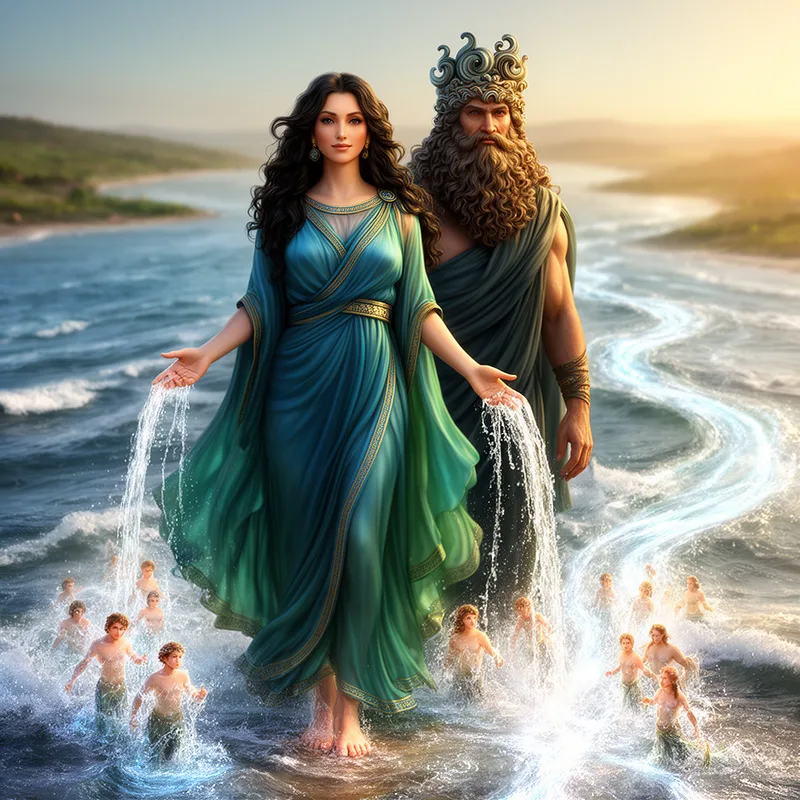
In Greek mythology, Tethys is celebrated as the nurturing mother of all rivers and streams.
-
Tethys, the wife of Oceanus, was often depicted as a beautiful goddess in ancient art.
-
The ancient Greeks believed that Tethys ruled over the oceans and provided them with countless resources.
Surface Forms
Etymology
Tethys comes from ancient Greek and was the name of a sea Titaness who was the wife of Oceanus. She was seen as the 'mother of rivers and ocean nymphs', so the name helps you remember something big and life-giving about the sea.