

Terrietia trifoliolata
- noun
- Australian
- The leaves of the Terrietia trifoliolata are easily identified by their three-part structure.
Examples
-
The Terrietia trifoliolata is valued for its height and lush foliage in tropical gardens.
-
In Australia, the Terrietia trifoliolata can grow over 30 meters tall and provides shade in sunny parks.
-
Researchers have recently documented new insect species living exclusively on the Terrietia trifoliolata.
-
The Terrietia trifoliolata is known for its large size.
-
Many gardeners admire the Terrietia trifoliolata for its unique leaves.
-
The Terrietia trifoliolata is a stunning tree known for its large, trifoliate leaves that add beauty to tropical landscapes.
-
Wildlife enthusiasts often observe various birds nesting in the branches of the Terrietia trifoliolata due to its dense foliage.
Synonyms
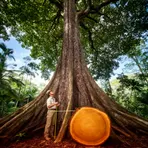
A large tree that grows in Australia and nearby islands with strong wood
Surface Forms
Morphology
Terrietia + trifoliolata
The form is a Latin binomial combining the genus name 'Terrietia' with the specific epithet 'trifoliolata', which can be parsed (tri- + foliol-) to mean 'having three leaflets', so the scientific name is compositionally describing a Terrietia with trifoliate leaves. However, 'trifoliolata' is not an English word and relies on knowledge of Latin/technical botanical morphology, so an average B1 learner who only knows the given English constituents would likely not fully derive this meaning.
Etymology
Terrietia trifoliolata is probably named after a person called Terrie, and the second word trifoliolata comes from Latin tri ('three') and foliolata ('small leaf'), so the name literally means 'three small leaves', which explains the tree's three-part leaves.

