
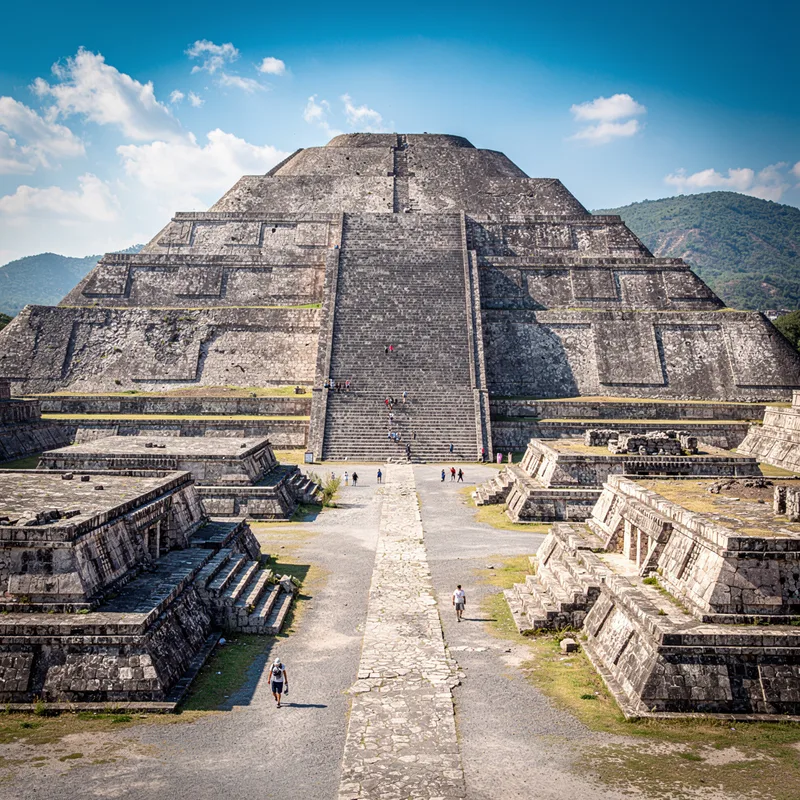
Teotihuacan
 3
9.9

- proper noun
- /ˌteɪ.oʊ.tɪˈwɑː.kɑːn/
- A map of Teotihuacan, left, was created during a scientific survey led by Leopoldo Batres in 1886.
- the city of Teotihuacan
- murals of Teotihuacan
- Teotihuacan site
Loading YouTube…
Watch on YouTubeSo we have the Teotihuacan Plateau.
- So we have the Teotihuacan Plateau.
- The Maya get conquered by in part by the Teotihuacan Empire from the West and then conquered by the Aztec Empire that comes from the West.
Examples
-
The ancient city of Teotihuacan is known for its impressive pyramids and rich history.
-
There were no enormous ruins like those at Teotihuacan or Chichen Itza.
Academic text (2006) -
Some archaeologists had believed he came from Teotihuacan, an influential city in the Mexican highlands.
Academic text (2007) -
Victors are portrayed using a complex of symbols that seem to have been borrowed from Teotihuacan.
Academic text (1991) -
The crucial period came after the waning of Teotihuacan influence around 600 C.E.
Academic text (1990) -
Judging by the headdress and other royal regalia, he had come from Teotihuacan, a massive city in distant highland Mexico.
Academic text (2007) -
The flower world and the flower mountain, in particular, are frequent elements in Teotihuacan art, most notably in ceramic censers and murals.
Academic text (2011) -
An ambitious multidisciplinary project for the valley of Teotihuacan was put together, combining archaeology, linguistics, and ethnography, as well as other emerging disciplines.
Academic text (2005) -
Many tourists visit Teotihuacan to explore its archaeological ruins and learn about its civilization.
-
Scholars study Teotihuacan to understand the cultural practices of pre-Columbian societies in central Mexico.
Surface Forms
Etymology
Teotihuacan comes from the Nahuatl language: the part teotl means 'god' and the ending -can means 'place', so the name says 'place of the gods' or 'where gods were born'. That fits the city, because its large pyramids and ruins show it was a holy place long ago.