
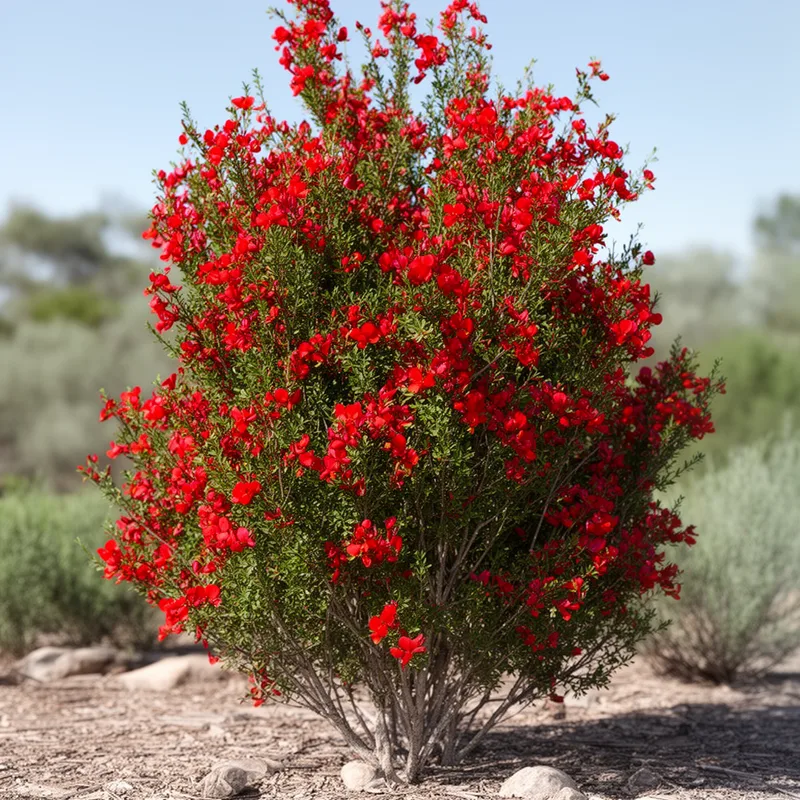
Templetonia retusa
- noun
- Australian
- The Templetonia retusa is often planted in Australian gardens for its vibrant scarlet blossoms.
Examples
-
Gardeners appreciate the drought tolerance of Templetonia retusa compared to other native species.
-
We spotted several Templetonia retusa shrubs along the hiking trail in Western Australia.
-
The Templetonia retusa is native to Australia.
-
Have you seen the Templetonia retusa blooming?
-
Gardeners appreciate the drought tolerance of Templetonia retusa because it thrives even in dry conditions.
-
The Templetonia retusa is often planted in Australian gardens for its brilliant scarlet flowers that attract birds.
-
We spotted several Templetonia retusa shrubs in bloom while hiking through the dry landscape of Western Australia.
Synonyms
A small Australian bush with bright red flowers

A small Australian shrub with bright red flowers often grown in gardens
Surface Forms
Morphology
Templetonia + retusa
This is a scientific Latin binomial: if a learner knows 'Templetonia' as a genus of shrubs they can infer the item is a plant/shrub, so the taxonomic category is somewhat transparent. However, the species epithet 'retusa' is not an English lexical item (and does not convey the specific features like scarlet flowers) and species names function largely as arbitrary labels, so the full descriptive meaning is not predictable from the constituents.
Etymology
Templetonia retusa was named for a naturalist called Templeton, and retusa is Latin for 'blunt' or 'notched', describing the leaf tip. So the name makes a simple picture: a shrub with blunt leaf tips and bright scarlet flowers called 'cockie's tongues'.

