
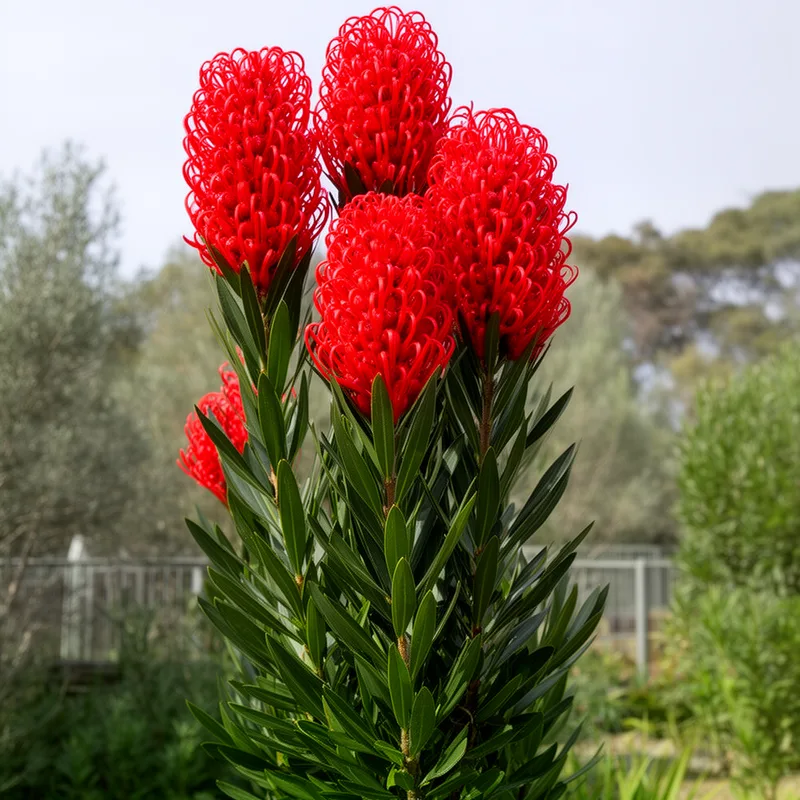
Telopea oreades
- noun
- Australian
- The Telopea oreades is admired for its striking red flowers and ornamental value in gardens.
Examples
-
The dense clusters of blossoms make the Telopea oreades a favorite among native plant enthusiasts.
-
The Telopea oreades blooms beautifully in spring.
-
Botanists often study the Telopea oreades to understand adaptation in Australian flora.
-
Have you seen a Telopea oreades in the wild?
-
The Telopea oreades showcases magnificent clusters of red flowers that attract many pollinators.
-
Gardeners often choose the Telopea oreades for its unique foliage and vibrant blooms.
-
In eastern Australia, the Telopea oreades can grow up to 2 meters tall, making it an impressive sight.
Synonyms


 1
9.9
A shrub or small tree from Australia with bright red flowers in dense groups
 1
9.9
A group of large Australian shrubs with bright, showy, often red flowers
How Tall

Surface Forms
Morphology
Telopea + oreades
This is a scientific Latin binomial (a species name) rather than a compositional English phrase; a B1 learner who knows the constituent tokens would not be able to derive the meaning 'a tall shrub' because 'oreades' is not a regular English word and the combination is a taxonomic label. Botanical Latin names are language-neutral and often arbitrary for general learners, so the meaning is not transparently built from the parts.
Etymology
Telopea oreades may get its name from Greek, where the part oreades points to 'mountain' or mountain spirits because this tall shrub often grows on high slopes. Its bright red flower clusters make it easy to spot, so the name helps remind us it is a striking plant of the mountains.