
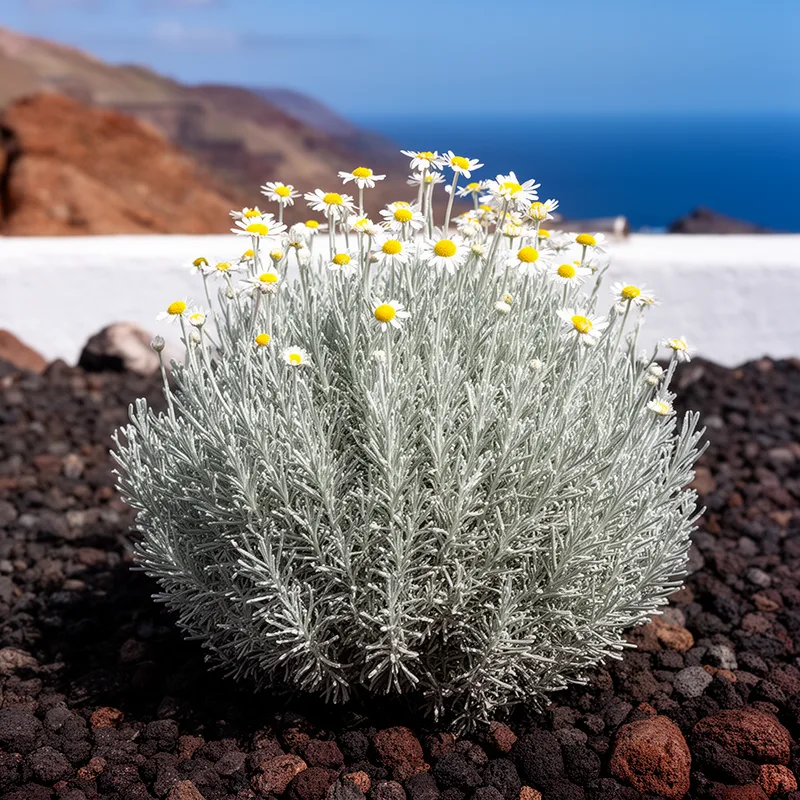
Tanacetum ptarmiciflorum
- noun
- Specialized
- The stems of Tanacetum ptarmiciflorum are notable for their dustlike down.
Examples
-
Botanists recently confirmed that Tanacetum ptarmiciflorum is native to the Canary Islands.
-
Tanacetum ptarmiciflorum is cultivated in gardens for its attractive silver foliage.
-
The Tanacetum ptarmiciflorum thrives in the warm climate of the Canary Islands.
-
You can find Tanacetum ptarmiciflorum growing in many gardens across the islands.
-
Tanacetum ptarmiciflorum is often admired for its striking white flowers in botanical gardens.
-
In the Canary Islands, Tanacetum ptarmiciflorum flourishes in the sunny climate and rocky soils.
-
Due to its unique hairy stems, Tanacetum ptarmiciflorum is a fascinating plant for horticulturists.
Synonyms

A bushy plant with white leaves and flowers and hairy stems from the Canary Islands
A small bush from the Canary Islands with white flowers and silvery leaves and hairy stems

A small bush with silvery leaves and white flowers
Surface Forms
Morphology
Tanacetum + ptarmiciflorum
This is a Latin binomial (a scientific plant name) rather than a compositional English phrase, so its meaning functions as a proper-label and is not derivable from everyday English words. One constituent is a technical genus name and the other is a non-English/rare form, so a B1 learner who knows the listed constituents would not be able to infer the plant description from them.
Etymology
Tanacetum ptarmiciflorum may come from the first part Tanacetum, an old word for 'tansy', and the second part ptarmiciflorum, from a Greek word for 'to sneeze'. This likely points to the plant's silver, dustlike hairs that can make you sneeze, so the name describes its dusty, silvery look.

