
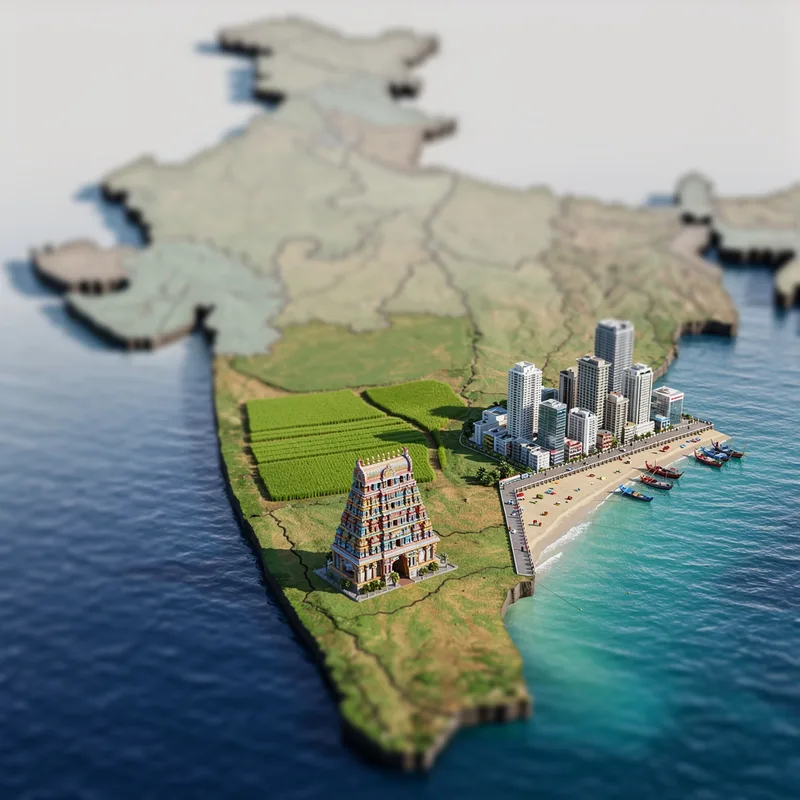
Tamil Nadu
 2
4.8

- proper noun
- /ˈtɑːmɪl ˈnɑːduː/
- The Indian state of Tamil Nadu is known for its rich cultural heritage and beautiful temples.
- state of Tamil Nadu
- Indian state of Tamil Nadu
- Tamil Nadu government
Examples
-
In Tamil Nadu, the annual Pongal festival is celebrated with great enthusiasm throughout the region.
-
The state of Tamil Nadu is on its west, and the bay is on its east.
Fiction book (1993) -
By October 1996, an estimated 2,000 reached the Indian state of Tamil Nadu to once again seek refuge.
Academic text (1997) -
As a result of these repatriations, roughly half of the original 110,000 refugees remain in Tamil Nadu, India.
Academic text (1997) -
Thekkady lies on the border between the states of Tamil Nadu and Kerala, in the high country of southwest India.
Fiction book (1993) -
The study was conducted in Chennai, the capital city of India's southern state, Tamil Nadu (Figure 1).
Academic text (2014) -
Approximately 78% of Chennai's population has access to tap water from a treated source and 58% to a piped sewage connection (Government of Tamil Nadu 2011).
Academic text (2014) -
Chennai, which is the capital of Tamil Nadu, is famous for its vibrant arts scene and delicious cuisine.
Surface Forms
Morphology
Tamil + Nadu
The name is compositionally 'Tamil' (the people/language) + 'nadu' (a Dravidian term meaning land/region), so a learner who knows both constituents can infer it refers to the land/region of the Tamils — i.e., a place/state. Although 'nadu' is a non‑English morpheme and may be unfamiliar to many learners, the semantic logic (ethnic name + place) is straightforward and cross‑linguistically recognizable.
Etymology
Tamil Nadu comes from two words in the local language: Tamil, the name of the people and their language, and Nadu, meaning 'land' or 'country'. So Tamil Nadu literally means 'land of the Tamil people', which is why it is the name of the Indian state where Tamil language and culture are found.