
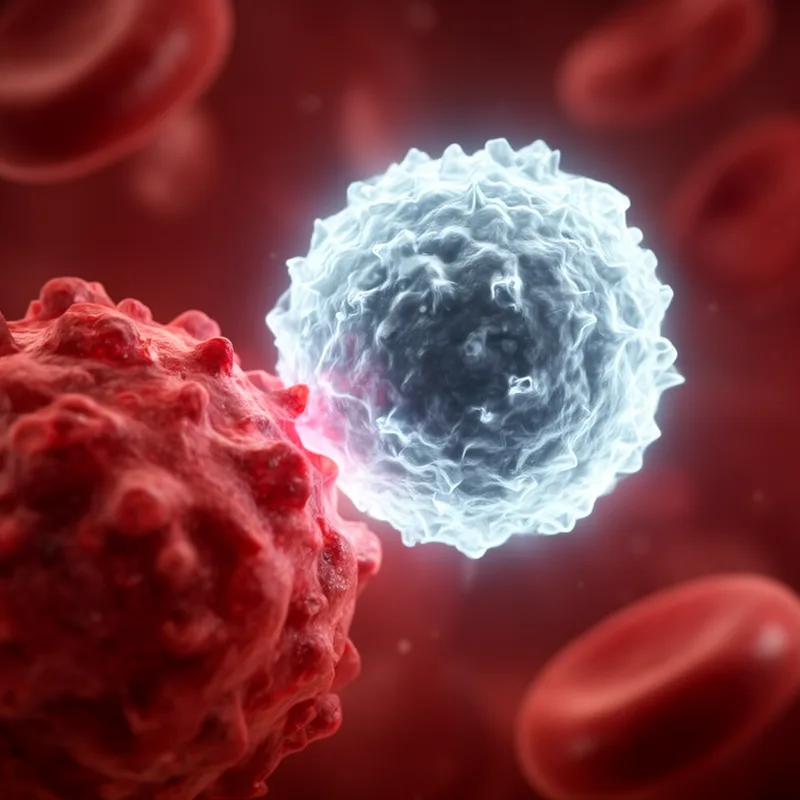
T cell
 26
4.2
26
4.2

- noun
- /tiː sɛl/
- Specialized
- There are two types of these guards, T cells and B cells.
- CD4 T cells
- activated T cells
- T cell receptor
Loading YouTube…
Watch on YouTubeThe main challenge to CAR T cells is their cost, which is enormous.
- The main challenge to CAR T cells is their cost, which is enormous.
- But once the virus gets inside our cells, only T cells can see them.
- Firstly, if we're talking about using CRISPR, are we using it in somatic cells such as T cells, or are we using it in embryos or germ stem cells?
- It has to match perfectly for that T cell to become mature.
- And it lays them all out for the T cells, the T cell receptor to detect.
- So PD one turns out to be another one of these checkpoints on T cells.
Examples
-
A group of lymphocytes cells called T cells, go in search of infected body cells and swiftly kill them off.
-
The immune response involves a type of small lymphocyte known as T cells that specifically target and destroy infected or cancerous cells.
-
Essentially what you do is take the T cells from a patient who has cancer.
-
So for example, T cells, we know that T cells help our body fight illness.
-
And we know, for example, that there are cells especially like the T cells in the lungs of people with COVID.
-
What we found is that T cells attack the entire spike, making T cells critically important.
-
OK, so here are typical T cell receptors on the surface of T cells.
-
As you age, your immune system and T cell function declines.
-
A normal T-cell count is anywhere between 500 and 1,500.
-
We were able to see very strong, robust antibody and T cell immune responses against our vaccine antigen.
Synonyms

 1
5.5
1
5.5
A white blood cell made in the thymus that fights infected or cancerous cells
Surface Forms
Morphology
T + cell
The element 'T' here is a letter/abbreviation standing for a specific immunological origin (thymus/T‑lymphocyte) rather than a normal lexical meaning; knowing 'T' as a letter plus 'cell' (microscopic unit) does not allow a B1 learner to infer the technical sense ‘type of immune lymphocyte’. This is specialized biomedical jargon rather than a compositionally transparent phrase, so the meaning is not derivable from the constituents.
Etymology
T cell gets its name from the 'thymus', because the letter T stands for the organ where these small cells learn to recognize enemies. They act like trained soldiers, finding and attacking infected or cancerous cells, so the name reminds us they are key fighters in the immune system.