
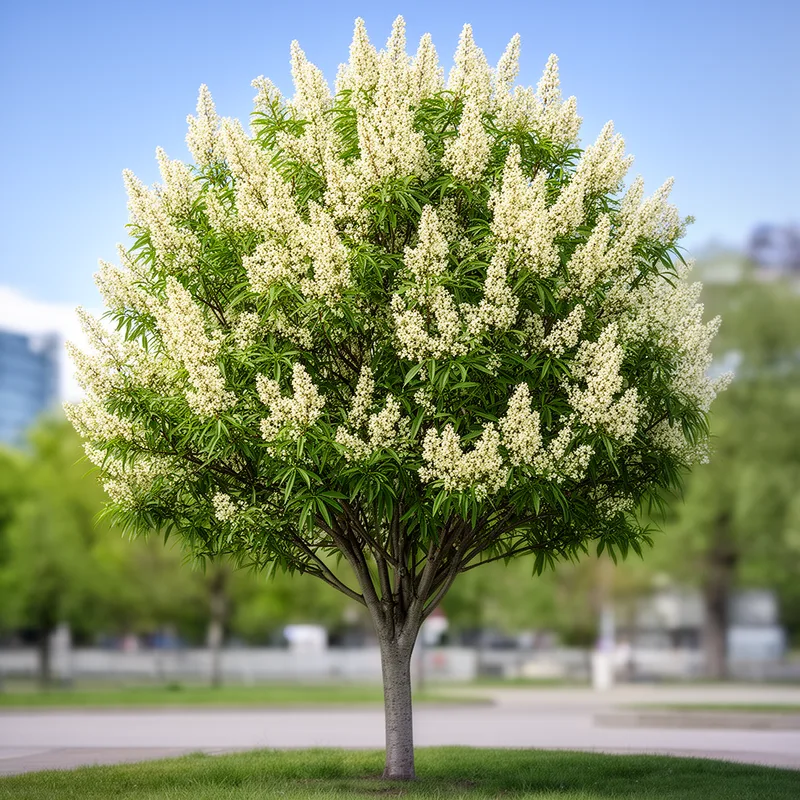
Syringa reticulata
- noun
- Specialized
- The Syringa reticulata is prized for its beautiful clusters of creamy-white flowers in early summer.
Examples
-
Many city parks have planted Syringa reticulata because it thrives in urban environments.
-
Many gardeners love Syringa reticulata for its fragrant flowers.
-
I chose Syringa reticulata for my garden to enjoy its fragrant blossoms and ornamental appeal.
-
The Syringa reticulata blooms beautifully in spring.
-
I chose Syringa reticulata for my garden to enjoy its fragrant blossoms and ornamental appeal.
-
Many city parks have planted Syringa reticulata because it thrives in urban environments.
-
The Syringa reticulata is prized for its beautiful clusters of creamy-white flowers in early summer.
Synonyms

A small tree from Japan with narrow leaves and groups of creamy white flowers grown for decoration

A small tree from Japan with narrow pointed leaves and pale white flowers
Surface Forms
Morphology
Syringa + reticulata
This is a Latin binomial botanical name rather than a normal English collocation; its parts are taxonomic/Latin (especially 'reticulata' which is not an ordinary English word), so a B1 learner who knows basic English words would not be able to derive 'Japanese tree lilac' from the constituents. Even if a learner recognised a cognate like 'reticulata' = 'reticulated', that morphological detail does not yield the species identity or common name, so the expression is not compositionally transparent.
Etymology
Syringa reticulata comes from old words that describe the tree. The name Syringa links to a Greek word for 'tube' because people used its hollow stems as simple pipes, and reticulata means 'net-like', for the fine net of lines on the leaves or bark, so the name helps you picture the tree.

