
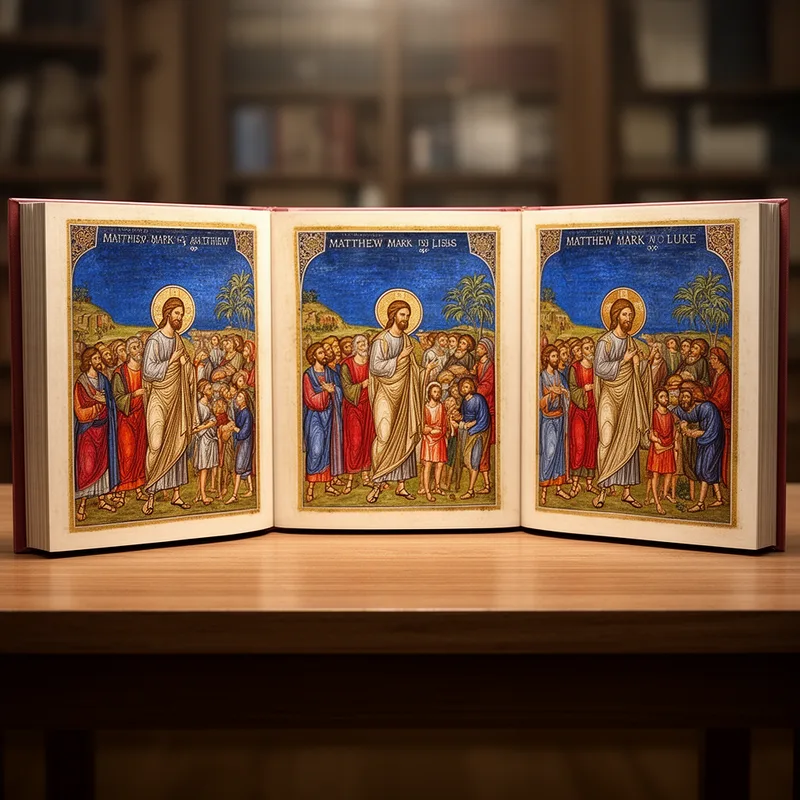
Synoptic Gospels


 1
8.7
1
8.7
- noun
- /sɪˈnɑptɪk ˈɡɑspəlz/
- Many Christians turn to the Synoptic Gospels for their narratives about the events leading up to the crucifixion of Jesus.
Examples
-
In all three synoptic Gospels, the disciples are called immediately after Jesus' baptism, and the post-resurrection stories focus on the band of disciples and Jesus' commission to them to preach and practice the gospel.
Academic text (1991) -
Scholars often study the similarities and differences found in the Synoptic Gospels to better understand the New Testament.
-
Let us turn now to the evidence from the Synoptic Gospels.
Academic text (1992) -
Beyond question, the Synoptic Gospels do not aim at presenting the inner life of Jesus, and as documents written out of faith, they cannot be read as "normal" historical sources.
Academic text (1992) -
In the synoptic Gospels—Matthew, Mark, and Luke—Jesus performs miracles on account of the faith of his audience.
Academic text (2006) -
The style of faith that we find in the Synoptic Gospels of Mark, Matthew, and Luke is quite different, as is the range of emotions it likely evoked in believers.
Academic text (2008) -
Even though we find these beliefs about judgment in all three Synoptic Gospels, they are so pointedly expressed in Matthew that I will name this style of faith "Matthean."
Academic text (2008) -
In that case, the synoptic Gospels would have used the Judean reckoning, with the day beginning at sunset, and John using the Roman reckoning of time, with the day beginning at sunrise.
Blog text (9) -
The Synoptic Gospels of Matthew, Mark, and Luke provide a similar account of Jesus' life and teachings.
Synonyms
 1
9.9
1
9.9
The first three books of the New Testament that tell similar stories about Jesus
Surface Forms
Morphology
The phrase is a straightforward adjective+noun composition: 'synoptic' (similar in content or viewpoint) applied to 'Gospels' yields 'the gospels that are similar in perspective/content.' This compositional meaning is directly derivable by a learner who knows both words (even if they might not identify the exact three books), and the pattern is cross-linguistically familiar.
Etymology
Synoptic Gospels comes from Greek parts syn ('together') and optic ('see'), creating the picture of the three books being 'seen together' side by side. Because Matthew, Mark and Luke tell many of the same stories and can be read next to each other, the phrase now means those three Gospels you can easily 'compare'.